Deliveroo vs Just Eat for UK Restaurants: Commission Rates, Reach & Hidden Costs Compared
Choosing between Deliveroo and Just Eat affects far more than delivery fees. This guide compares commission structures, customer reach, operational differences, hidden costs, and long-term profitability, helping UK restaurant owners decide which platform best fits their business in 2026.
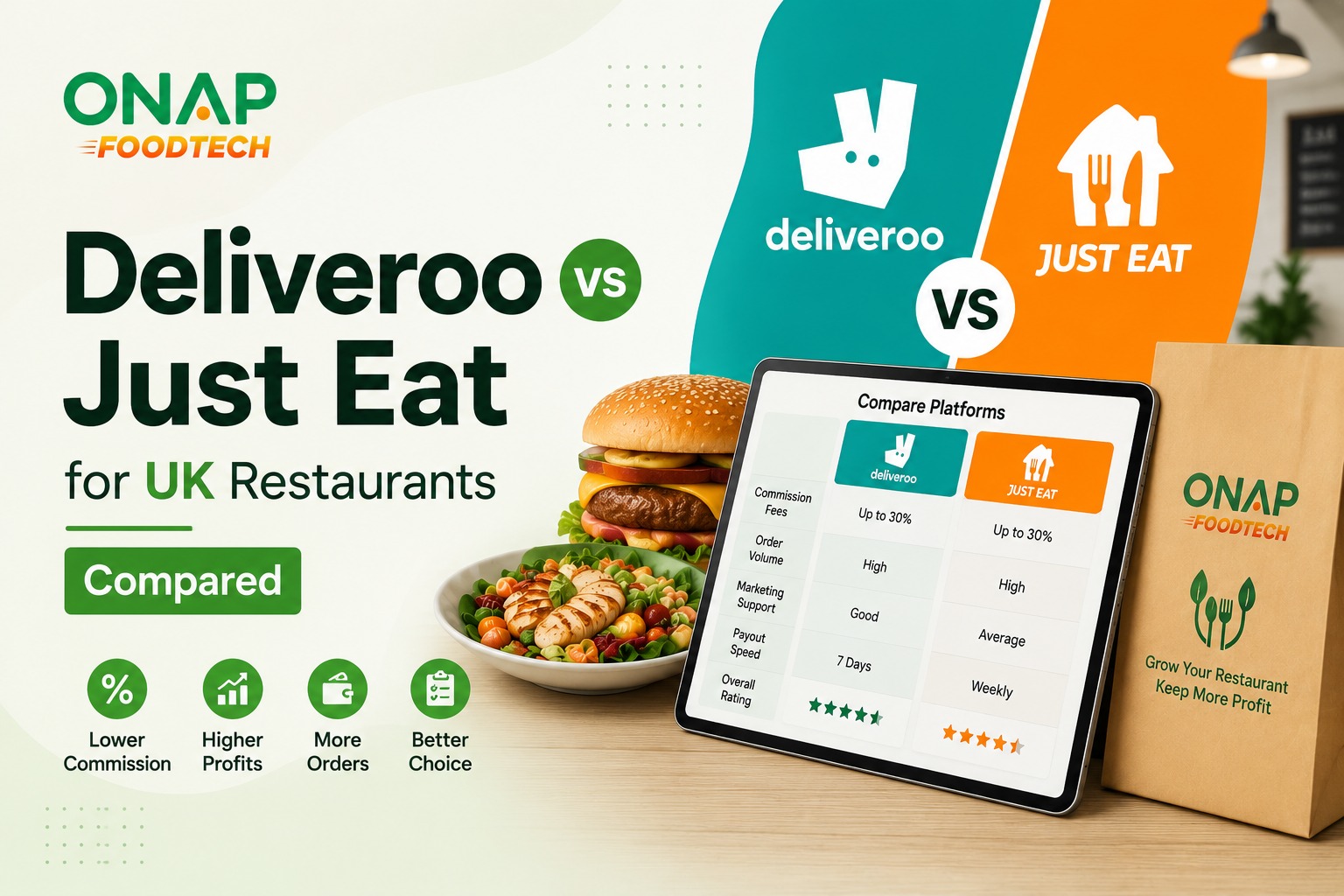
Table of Contents
- Deliveroo vs Just Eat for UK Restaurants: Commission Rates, Reach & Hidden Costs Compared
- Understanding How Deliveroo and Just Eat Operate
- Commission Rates: What Restaurants Should Expect
- Customer Reach and Brand Visibility
- Delivery Experience and Operational Control
- Hidden Costs Restaurants Often Miss
- Who Wins on Customer Data?
- Marketing Opportunities on Each Platform
- Which Platform Is Better for Different Restaurant Types?
- Marketplace Dependence Carries Long-Term Risk
- Deliveroo vs Just Eat: Which Offers Better Value?
- Should Restaurants Move Beyond Marketplace Dependence?
- Frequently Asked Questions
- Conclusion
Deliveroo vs Just Eat for UK Restaurants: Commission Rates, Reach & Hidden Costs Compared
A comparison between Deliveroo and Just Eat comes down to more than commission rates. Both platforms help restaurants attract online orders, but they differ in customer demographics, delivery models, marketing tools, operational flexibility and long-term profitability. The right choice depends on your restaurant's goals, location and existing sales channels.
Food delivery remains one of the biggest revenue channels for UK hospitality. According to UKHospitality, digital ordering continues to play an important role in restaurant growth, while consumer research from Ofcom shows smartphone ordering has become routine for millions of UK diners. Those trends explain why choosing the right marketplace deserves careful evaluation rather than focusing only on headline commission percentages.
Understanding How Deliveroo and Just Eat Operate
Although both platforms connect restaurants with customers, they were built with different operating models. launched as a logistics-first platform. Its network of riders became its biggest selling point, allowing restaurants without their own delivery drivers to offer takeaway across larger delivery zones.
Just Eat began primarily as an online marketplace connecting customers with restaurants that often managed their own deliveries. Over time it expanded its own courier network, although many independent restaurants still use their own drivers through the platform.
That difference still influences how each platform works today.
| Feature | Deliveroo | Just Eat |
|---|---|---|
| Primary focus | Marketplace with integrated courier network | Marketplace supporting both own drivers and courier delivery |
| Restaurant delivery option | Mostly Deliveroo riders | Restaurant drivers or Just Eat delivery |
| Typical customer perception | Premium convenience | Broad local takeaway marketplace |
| Best known for | Fast delivery | Large takeaway selection |
Commission Rates: What Restaurants Should Expect
Commission is often the first comparison owners make. The practical reality is that neither platform publishes one fixed commission rate because agreements vary by location, restaurant type and commercial negotiations.
Restaurants generally encounter costs made up of:
- Marketplace commission
- Delivery charges (where applicable)
- Payment processing
- Promotional campaigns
- Optional advertising products
Many operators discover that commission percentages tell only part of the story. A platform charging a lower percentage may generate fewer profitable orders, while another charging more may produce higher average basket values or stronger customer frequency. The better comparison is total profit per order rather than commission alone.
Customer Reach and Brand Visibility
Deliveroo and Just Eat attract different audiences. Deliveroo has built a reputation among urban professionals, premium casual dining brands and customers looking for quick delivery from recognised restaurants. Just Eat has broader national coverage and remains particularly strong for local takeaways, independent restaurants and suburban markets. For many independent operators, visibility matters just as much as traffic volume.
Questions worth asking include:
- Which platform dominates your postcode?
- Which competitors appear first?
- What cuisines perform well?
- How many restaurants compete directly beside yours?
Checking your own trading area often provides more useful insight than national comparisons.
Delivery Experience and Operational Control
Delivery quality influences customer satisfaction long after the order leaves the kitchen. Deliveroo manages much of the logistics through its rider network, reducing staffing pressures for restaurants that do not employ drivers. That convenience comes with less operational control.
Restaurants relying on their own drivers through Just Eat often have greater flexibility over:
- Delivery radius
- Driver training
- Customer communication
- Local scheduling
- Brand presentation
For businesses already employing drivers, this can reduce dependence on third-party logistics.
Hidden Costs Restaurants Often Miss
Commission is only one expense. Restaurant owners frequently overlook indirect costs that affect profitability.
These may include:
- Sponsored listings
- Discount campaigns
- Voucher participation
- Packaging upgrades
- Customer compensation
- Refund adjustments
- Order error costs
- Operational labour
Promotions deserve particular attention. Participating in platform-wide discount campaigns may increase order numbers, but margins can shrink quickly if discounts are funded by the restaurant rather than shared with the platform. Experienced operators regularly calculate contribution margin after every deduction instead of measuring success through order volume alone.
Who Wins on Customer Data?
This is one of the biggest strategic differences between marketplaces and direct ordering. Neither Deliveroo nor Just Eat provides restaurants with complete ownership of customer relationships in the same way as direct ordering platforms. Restaurants receive limited customer information compared with orders placed through their own website or branded ordering app.
That creates challenges when trying to:
- Build loyalty programmes
- Send personalised offers
- Encourage repeat visits
- Analyse purchasing behaviour
- Reduce dependence on marketplace traffic
Many restaurants therefore use marketplaces primarily for customer acquisition while encouraging repeat customers to order directly later. This approach often produces stronger long-term margins. For operators exploring this strategy, our guide to an online ordering system for restaurants explains how direct ordering complements marketplace sales rather than replacing them.
Marketing Opportunities on Each Platform
Both platforms offer promotional tools, although they differ in execution.
Deliveroo provides:
- Sponsored placements
- Featured restaurant campaigns
- Discount promotions
- Collection offers
Just Eat offers:
- Featured listings
- Voucher campaigns
- Promotional visibility
- Seasonal marketing opportunities
Paid promotion can increase visibility, but restaurants should monitor return on investment carefully. A campaign generating twice the order volume is not automatically successful if average profit per order falls.
Which Platform Is Better for Different Restaurant Types?
No single answer fits every business.
| Restaurant Type | Deliveroo | Just Eat |
|---|---|---|
| Independent takeaway | Good | Excellent |
| Premium casual dining | Excellent | Good |
| Fine dining delivery | Strong | Moderate |
| Pizza delivery | Strong | Strong |
| Multi-site chain | Excellent | Excellent |
| Rural restaurant | Limited in some areas | Often stronger coverage |
| Restaurant with own drivers | Moderate | Excellent |
The assumption many owners make is that larger brands automatically perform better on Deliveroo. In practice, success depends more on local competition, cuisine, delivery speed and customer reviews than brand size alone.
Marketplace Dependence Carries Long-Term Risk
Food delivery marketplaces provide valuable exposure. They also create dependency. If most online revenue comes through one platform, changes in commission, ranking algorithms or promotional policies can affect profitability overnight. Many successful restaurant groups now focus on balancing marketplace orders with direct ordering.
A healthy mix might include:
- Marketplace discovery
- Restaurant website ordering
- Loyalty programme
- CRM marketing
- Email campaigns
- SMS promotions
- Click and collect
This creates more predictable revenue and stronger customer retention. Restaurants considering that approach can explore the customer engagement features available through ONAP FoodTech, including loyalty, CRM and direct online ordering.
Deliveroo vs Just Eat: Which Offers Better Value?
The answer depends on what "value" means for your business.
Choose Deliveroo if you prioritise:
- Fast courier delivery
- Urban customer reach
- Premium positioning
- Strong logistics support
Choose Just Eat if you value:
- Wider local coverage
- Existing delivery drivers
- Established takeaway audience
- Greater delivery flexibility
Many multi-site operators use both platforms while investing steadily in direct ordering to improve long-term margins. Our comparison of restaurant management software for UK restaurants explains how integrated technology can help manage orders from multiple channels without increasing administrative work.
Should Restaurants Move Beyond Marketplace Dependence?
Marketplace apps remain valuable customer acquisition channels. The bigger opportunity comes after the first order. Restaurants that encourage repeat customers to order directly often reduce commission costs while improving customer lifetime value. Features such as loyalty rewards, personalised offers, CRM automation and branded ordering websites help create that transition without abandoning marketplace visibility. Businesses comparing direct ordering solutions can also review the available FoodTech pricing options when evaluating the financial case for reducing marketplace reliance.
Frequently Asked Questions
Which platform charges lower commission, Deliveroo or Just Eat?
There is no universal answer. Commission varies depending on commercial agreements, delivery arrangements and optional marketing services. Restaurants should compare total operating costs rather than headline percentages.
Is Deliveroo better than Just Eat for independent restaurants?
Not always. Deliveroo performs well in many urban markets, while Just Eat often has stronger recognition among local takeaway customers. Local demand usually matters more than national popularity.
Can restaurants use both Deliveroo and Just Eat?
Yes. Many restaurants operate on multiple platforms to increase visibility and reduce dependence on a single source of online orders. Software integrations can help manage orders efficiently across channels.
Is it cheaper to build your own ordering system?
A direct ordering platform removes marketplace commission on future orders, although it requires investment in marketing and customer retention. Many restaurants use both approaches together rather than choosing one exclusively.
Which platform is better for customer loyalty?
Neither marketplace provides the same level of customer ownership as direct ordering. Restaurants wanting stronger loyalty programmes usually invest in their own CRM and online ordering platform alongside marketplace listings.
Conclusion
Profit per order. Restaurants should consider delivery costs, marketing spend, refund rates, operational efficiency, repeat business and customer lifetime value instead of comparing commission percentages alone. The strongest marketplace strategy is rarely about choosing one platform forever. It is about understanding how each contributes to customer acquisition while building direct relationships that improve margins over time. Restaurants that balance marketplace visibility with their own ordering channels place themselves in a stronger position to protect profit as commission structures and consumer behaviour continue to evolve.
Explore More Blogs
Discover more expert insights, software guides, and industry best practices to help your business grow with ONAP.
How to Launch a Branded Restaurant App Without a Developer (UK Guide 2026)
Launching a branded restaurant app no longer requires an in-house development team. This 2026 UK guide explains how restaurant owners can choose a no-code or managed app platform, connect ordering and payments, build loyalty features, publish the app, and avoid the common mistakes that make app projects expensive.
Field Service Engineer Scheduling Software UK: Free vs Paid Options Compared
Field service engineer scheduling software helps UK contractors assign jobs, manage availability, track engineers and keep customers updated. This guide compares free scheduling tools, spreadsheets and paid field service platforms, including their features, limitations, costs and suitability for growing teams.
Café vs Cloud Kitchen vs Dark Kitchen: Which Model Works Best for UK Food Businesses
Cafés, cloud kitchens and dark kitchens each suit different UK food businesses. This guide compares premises, staffing, startup costs, delivery economics, customer acquisition, technology, VAT and growth potential, helping operators choose the model that fits their menu, target market and available capital.