Café vs Cloud Kitchen vs Dark Kitchen: Which Model Works Best for UK Food Businesses
Cafés, cloud kitchens and dark kitchens each suit different UK food businesses. This guide compares premises, staffing, startup costs, delivery economics, customer acquisition, technology, VAT and growth potential, helping operators choose the model that fits their menu, target market and available capital.
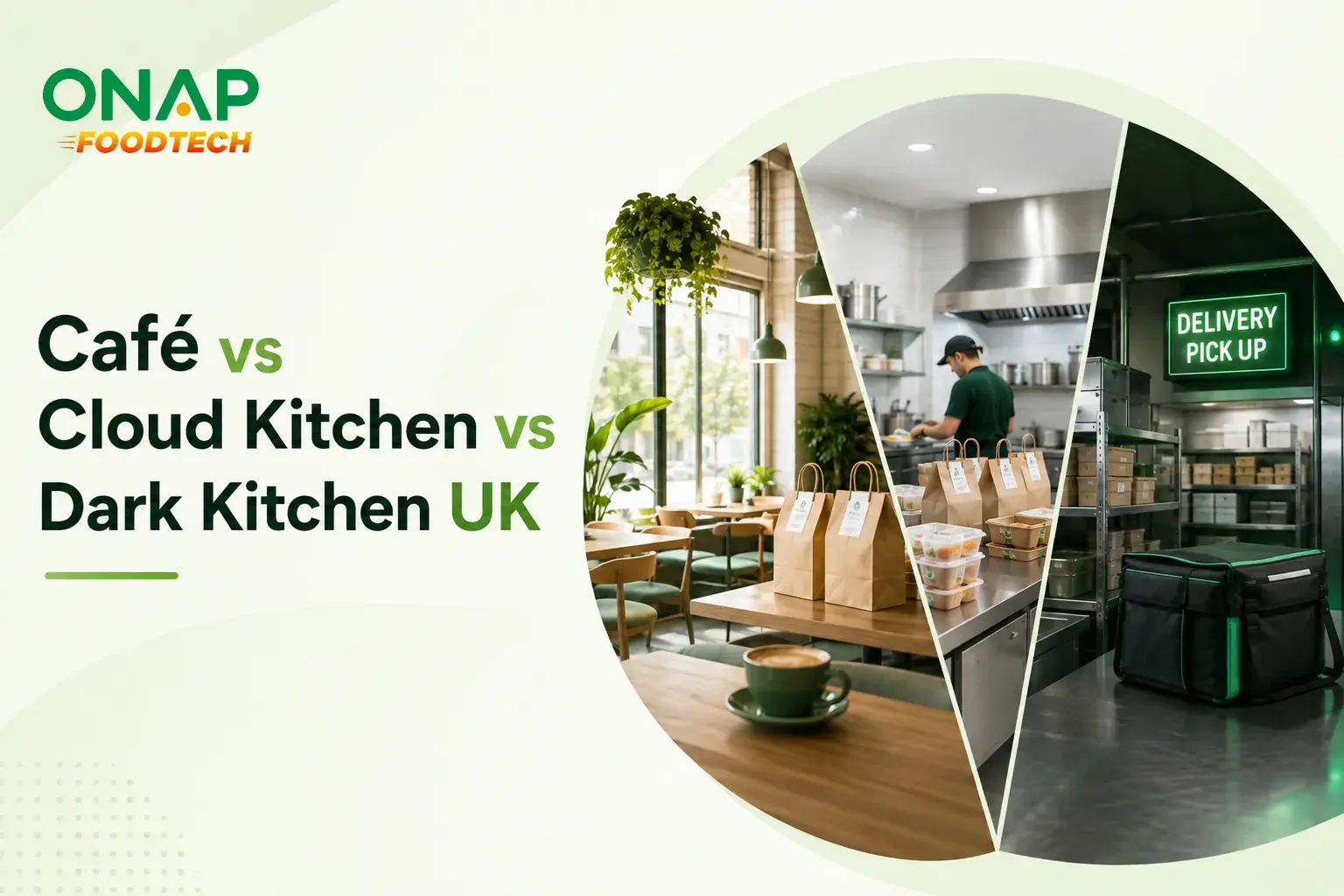
Table of Contents
- Café vs cloud kitchen vs dark kitchen: what is the difference?
- What makes a café model work in the UK?
- When does a cloud kitchen make more sense?
- Dark kitchen vs cloud kitchen: are they actually different?
- Café vs cloud kitchen: which has better margins?
- What should a UK food business choose?
- Common mistakes when choosing a food business model
- How technology changes the economics
- Frequently asked questions
- Is a cloud kitchen cheaper than opening a café in the UK?
- What is the difference between a dark kitchen and a ghost kitchen?
- Can a café also operate as a cloud kitchen?
- Do dark kitchens need to register as food businesses in the UK?
- Is a café or dark kitchen better for a new restaurant brand?
- Should a restaurant use both delivery and dine-in?
- Conclusion
A café vs cloud kitchen vs dark kitchen decision comes down to how you want customers to buy, where food is prepared and how much you want to spend on premises and service. A café earns through an in-person experience, while cloud and dark kitchens focus on delivery and collection, usually with far less customer-facing space.
The distinction matters more in the UK than the labels suggest. Hospitality businesses are operating under heavy cost pressure, with UKHospitality reporting that one-third of surveyed businesses were operating at a loss in 2025. Choosing the wrong property model can leave an otherwise strong food concept carrying costs that its sales mix cannot support.
Café vs cloud kitchen vs dark kitchen: what is the difference?
A café is a customer-facing food business with seating or an identifiable service area. A cloud kitchen is a delivery-led kitchen that may support one or several food brands without a conventional dining room. A dark kitchen is also delivery-focused, but the term is often used for a kitchen deliberately hidden from customers, with little or no public-facing operation.
The terminology overlaps. A delivery-only kitchen can be described as a cloud kitchen, dark kitchen, ghost kitchen or virtual kitchen depending on the operator and market. The commercial question is less about the label and more about whether the premises, menu and ordering model produce enough contribution per order.
| Factor | Café | Cloud kitchen | Dark kitchen |
|---|---|---|---|
| Customer experience | In person, plus takeaway | Mainly delivery and collection | Mainly delivery |
| Dining space | Usually required | Usually none | None or minimal |
| Property cost | Higher | Lower | Lower |
| Staffing | Front and back of house | Primarily kitchen and dispatch | Primarily kitchen and dispatch |
| Delivery dependence | Low to moderate | High | High |
| Brand discovery | High street, signage, walk-ins | Digital channels | Digital channels |
| Menu flexibility | Moderate | High | High |
| Multiple brands | Possible | Common | Common |
| Best suited to | Café-led experiences and local trade | Delivery-first concepts | High-volume delivery concepts |
| Main commercial risk | Rent and labour | Platform fees and demand | Platform dependence and weak differentiation |
The practical reality is that none of these models is automatically cheaper or more profitable. A small café in a strong commuter location may outperform a delivery kitchen because it captures coffee, breakfast, lunch and impulse purchases without paying a delivery platform for every transaction.
What makes a café model work in the UK?
A café works best when the location itself contributes to demand. Footfall, visibility, nearby offices, schools, transport links and residential density can matter as much as the menu. A 40-seat café beside a railway station has a different economic model from a neighbourhood café in a suburban parade. The first may depend on morning coffee, breakfast and takeaway lunch. The second may rely more heavily on repeat local customers, weekend visits and community trade.
The strengths of a café
The biggest advantage is direct customer contact. Staff can recommend products, build relationships and encourage repeat visits without relying entirely on an ordering platform.
A physical site also creates several revenue opportunities:
- Coffee and drinks
- Breakfast and brunch
- Lunch
- Cakes and bakery products
- Takeaway orders
- Retail products
- Private hire or small events
- Loyalty-led repeat visits
For a business built around atmosphere, hospitality or premium presentation, that physical experience is difficult to reproduce through a delivery app. Customer acquisition can also be cheaper over time. A regular who buys a £4 coffee several times a week may become more valuable than a delivery customer who arrives through a paid marketplace and never returns directly.
Where the café model becomes difficult
Property is the obvious burden. Rent, business rates, utilities, repairs, cleaning, furniture and front-of-house labour continue during quiet periods. Labour is another consideration. A café serving customers from 7am to 4pm needs people on site before opening and after closing. A kitchen serving delivery orders can often organise labour more tightly around order peaks.
The current UK environment makes this particularly relevant. UKHospitality reported in April 2026 that 64% of surveyed hospitality businesses expected to cut jobs because of cost increases, while 42% expected to reduce trading hours. For a café, the question is therefore not just whether customers like the concept. It is whether enough transactions occur at a sufficient average value to cover the building and the people needed to operate it. A useful test is to model a normal Tuesday, not a packed Saturday. If the business only looks attractive when every table is occupied, the property may be too expensive.
When does a cloud kitchen make more sense?
A cloud kitchen removes much of the customer-facing infrastructure from the business. Food is prepared for delivery or collection, with orders arriving through direct ordering channels, marketplaces or both.This can make sense for a concept where food quality travels well and customers care more about convenience than the dining environment. Burgers, pizza, fried chicken, curries, noodles and many meal-box concepts can fit this model, although the menu still needs to be designed around delivery time and packaging.
The UK delivery market is substantial. Lumina Intelligence forecast the UK food delivery market at £14.3 billion in 2025, up 3.1% year on year. It also reported that delivery represented around 19.9% of total foodservice occasions. That creates opportunity, but delivery demand does not remove commercial pressure.
The main advantages of a cloud kitchen
The first advantage is property efficiency. You do not need a dining room, customer toilets, expensive furniture or a prominent retail frontage. A kitchen in a less expensive location may therefore give an operator access to a larger production area for the same property budget. Cloud kitchens can also test new concepts quickly. A restaurant group with an established kitchen might introduce a delivery brand aimed at a different customer segment without opening another full restaurant.
That makes the model attractive for experimentation. Suppose a Manchester operator already has a kitchen producing grilled chicken. It could test a separate lunch-focused brand online, measure order volume and repeat purchase, then decide whether the concept deserves a permanent site.
The hidden costs of delivery-only operations
The assumption that a delivery kitchen is automatically low-cost is one of the most common mistakes. The rent may be lower, but customer acquisition can become more expensive. Marketplace commissions, promotions, packaging, delivery costs, refunds and advertising can consume a large share of each order.
Customer ownership also matters. If most orders come through third-party marketplaces, the operator has less control over the customer relationship than a business taking orders directly. That is why a good delivery operation needs more than a kitchen. It needs a clear online ordering strategy, accurate menus, reliable fulfilment, customer data and a plan for encouraging repeat orders. A dedicated online ordering system for UK restaurants can help operators build a direct channel alongside marketplace sales, provided the economics work for the individual business.
Dark kitchen vs cloud kitchen: are they actually different?
Dark kitchens and cloud kitchens are often treated as the same model, and commercially they can be. The distinction is usually about how the kitchen is positioned and operated rather than a separate legal business category. A dark kitchen is generally designed to remain invisible to the customer. It may sit in an industrial unit, shared kitchen facility or purpose-built delivery site. A cloud kitchen can describe the wider delivery-first operating model, including facilities that host several brands.
For an operator, the important questions are practical:
- How much rent and service charge will the site carry?
- What extraction, drainage and electrical capacity does it have?
- How many orders can the kitchen handle at peak?
- How much will delivery and marketplace fees cost?
- Can customers collect orders?
- Is there enough demand within the delivery radius?
- Can the site support more than one concept?
The last point is where dark kitchens can become attractive. A single production facility might support several menus, provided each brand has enough demand and the operation does not become confusing for kitchen staff.
Café vs cloud kitchen: which has better margins?
Neither model guarantees better margins. The stronger choice depends on sales mix, property cost, labour requirements, order value and customer acquisition cost. A café has higher fixed overheads but can keep more control over the customer relationship. A cloud kitchen can carry lower premises costs but may surrender a meaningful portion of revenue to delivery marketplaces and paid acquisition.
For example, imagine two businesses each generating £40,000 in monthly sales. The café might spend heavily on rent, rates, utilities and front-of-house wages but retain strong direct sales. The delivery kitchen might have lower premises costs but spend more on marketplace commissions, promotions, packaging and delivery. The revenue figure alone tells you almost nothing.
Experienced buyers usually build a contribution model that separates:
- Food cost
- Packaging
- Labour
- Rent and property costs
- Delivery costs
- Marketplace fees
- Payment processing
- Marketing
- Refunds and wastage
The useful number is what remains after the costs directly associated with producing and selling each order.
What should a UK food business choose?
The right model usually follows the customer behaviour you want to serve rather than the premises you happen to find.
| Business situation | Best starting model | Reason |
| Strong high-street footfall | Café | Captures walk-in and repeat trade |
| Delivery-first menu | Cloud kitchen | Lower customer-facing property costs |
| Multiple digital brands | Dark/cloud kitchen | Shared production can support several concepts |
| Premium coffee and hospitality experience | Café | Physical experience adds value |
| New concept with limited capital | Cloud kitchen | Easier to test without a full dining room |
| Established delivery brand | Cloud or dark kitchen | Production can be separated from customer experience |
| Community-led neighbourhood concept | Café | Local relationships support repeat visits |
| High delivery density in urban area | Cloud or dark kitchen | Shorter delivery distances can support order economics |
For many new operators, a phased approach is safer than choosing a permanent format immediately. The reverse approach is harder. Once a business has committed to a long lease and spent heavily on a fit-out, changing the model can be expensive.
Common mistakes when choosing a food business model
Choosing a site before proving demand
A beautiful unit is not a business model. Check delivery demand, pedestrian traffic, competitor density and customer spending patterns before committing to property.
Treating marketplace sales as free sales
They are not. Model commissions, promotions and customer acquisition costs against the gross order value. A £25 order can contribute far less than the headline figure suggests.
Building a menu that does not travel
Café food does not automatically make good delivery food. Fries soften, fried products lose texture and plated dishes can arrive looking very different from the kitchen presentation.
Run delivery tests before launch. Order the food yourself from several distances and assess temperature, presentation and portion size.
Launching too many virtual brands
Three menus sharing ingredients can make sense. Three brands requiring different prep, packaging and stock can create operational friction and waste.
Start with one clear proposition unless there is a strong reason to split the offer.
Ignoring direct customer relationships
Marketplaces can provide reach, but an operator should know how many customers return directly, how often they order and what they spend. A restaurant CRM system can support this type of customer analysis when the operation has enough data to make it useful.
How technology changes the economics
Technology matters more once a business has multiple ordering channels. A café may need EPOS, payments, table management, loyalty, stock control and online ordering. A cloud kitchen may place more emphasis on order aggregation, kitchen workflow, delivery integrations, menu management, customer data and reporting.
The key is integration. If orders arrive from a website, marketplace and phone, staff should not have to re-enter each order manually. Likewise, customer and sales information should not be trapped in separate systems if the operator needs a reliable view of performance.
Before buying software, map the actual operation. List every sales channel, payment method, delivery connection, customer database and reporting requirement. Then check what connects natively and what requires a third-party integration. FoodTech's restaurant software features are relevant for operators assessing these requirements, particularly where direct ordering, CRM, loyalty and analytics need to sit within one operating setup.
Frequently asked questions
Is a cloud kitchen cheaper than opening a café in the UK?
A cloud kitchen can have lower property and front-of-house costs than a café, but it is not automatically cheaper to operate. Delivery commissions, packaging, advertising, refunds and technology can absorb much of the saving. The comparison should therefore use contribution per order and monthly fixed costs rather than rent alone. A low-rent kitchen with weak demand can still lose money faster than a well-located café.
What is the difference between a dark kitchen and a ghost kitchen?
Dark kitchen and ghost kitchen usually describe the same broad idea: a food production site without a conventional customer-facing restaurant. Cloud kitchen is a wider term that can describe delivery-focused kitchens serving one or several brands. The terminology varies between operators, landlords and technology providers, so the practical issues are site cost, capacity, delivery radius, staffing and order economics.
Can a café also operate as a cloud kitchen?
Yes, a café can add a delivery-first operation alongside its physical trade. The challenge is protecting the in-store customer experience while managing delivery peaks. A café with spare kitchen capacity during quieter periods may have a useful opportunity to add delivery sales, but the menu should be designed around preparation capacity rather than adding orders indiscriminately.
Do dark kitchens need to register as food businesses in the UK?
Yes, a dark kitchen is still a food business and must meet applicable food safety and registration requirements. The Food Standards Agency says new food businesses should register with their local authority at least 28 days before trading begins. Operators should also check premises, planning, extraction, waste, fire safety and other local requirements before opening.
Is a café or dark kitchen better for a new restaurant brand?
A dark or cloud kitchen can be a lower-risk way to test a delivery-led restaurant concept because it avoids the cost of a full dining room. A café can be the better choice when location, atmosphere and personal service are central to the brand. The decision should follow customer demand, menu suitability and projected contribution rather than a general assumption that one format is cheaper.
Should a restaurant use both delivery and dine-in?
Using both can work when the kitchen has enough capacity and the two channels support each other. A café can use delivery to generate sales outside peak footfall periods, while a delivery-first operator can add collection or limited seating later. The important test is operational capacity: if delivery orders slow service for paying dine-in customers, the extra revenue may not justify the disruption.
Conclusion
Before choosing a premises model, build three 12-month forecasts: one for a café, one for a cloud kitchen and one for a dark kitchen. Use the same menu, realistic order volumes and local costs, then compare rent, labour, food cost, packaging, VAT, marketplace fees, marketing and expected repeat business.
For operators who already know the numbers but need to compare software requirements, FoodTech pricing and plans can be assessed alongside the wider operating budget. The winning model is not the one with the lowest rent or the highest sales forecast. It is the format that leaves enough contribution after every cost to support the business through quiet weeks, rising costs and the next stage of growth.
Explore More Blogs
Discover more expert insights, software guides, and industry best practices to help your business grow with ONAP.
How to Launch a Branded Restaurant App Without a Developer (UK Guide 2026)
Launching a branded restaurant app no longer requires an in-house development team. This 2026 UK guide explains how restaurant owners can choose a no-code or managed app platform, connect ordering and payments, build loyalty features, publish the app, and avoid the common mistakes that make app projects expensive.
Field Service Engineer Scheduling Software UK: Free vs Paid Options Compared
Field service engineer scheduling software helps UK contractors assign jobs, manage availability, track engineers and keep customers updated. This guide compares free scheduling tools, spreadsheets and paid field service platforms, including their features, limitations, costs and suitability for growing teams.
Plumbing Business Software UK: What Features Actually Matter in 2026
Choosing plumbing business software in the UK is less about having the longest feature list and more about controlling jobs, engineers, quotes, invoices and compliance from one place. This 2026 guide explains which features genuinely matter, what to avoid paying for, how integrations affect day-to-day work, and how to assess software before committing your business to a new system.