Online Ordering System for UK Restaurants: The Commission-Free Guide
Discover how an online ordering system for UK restaurants helps reduce commission costs, strengthen customer relationships, and increase profit margins. This guide explains direct ordering, essential features, setup considerations, marketing strategies, and how to run your own ordering channel alongside delivery marketplaces.
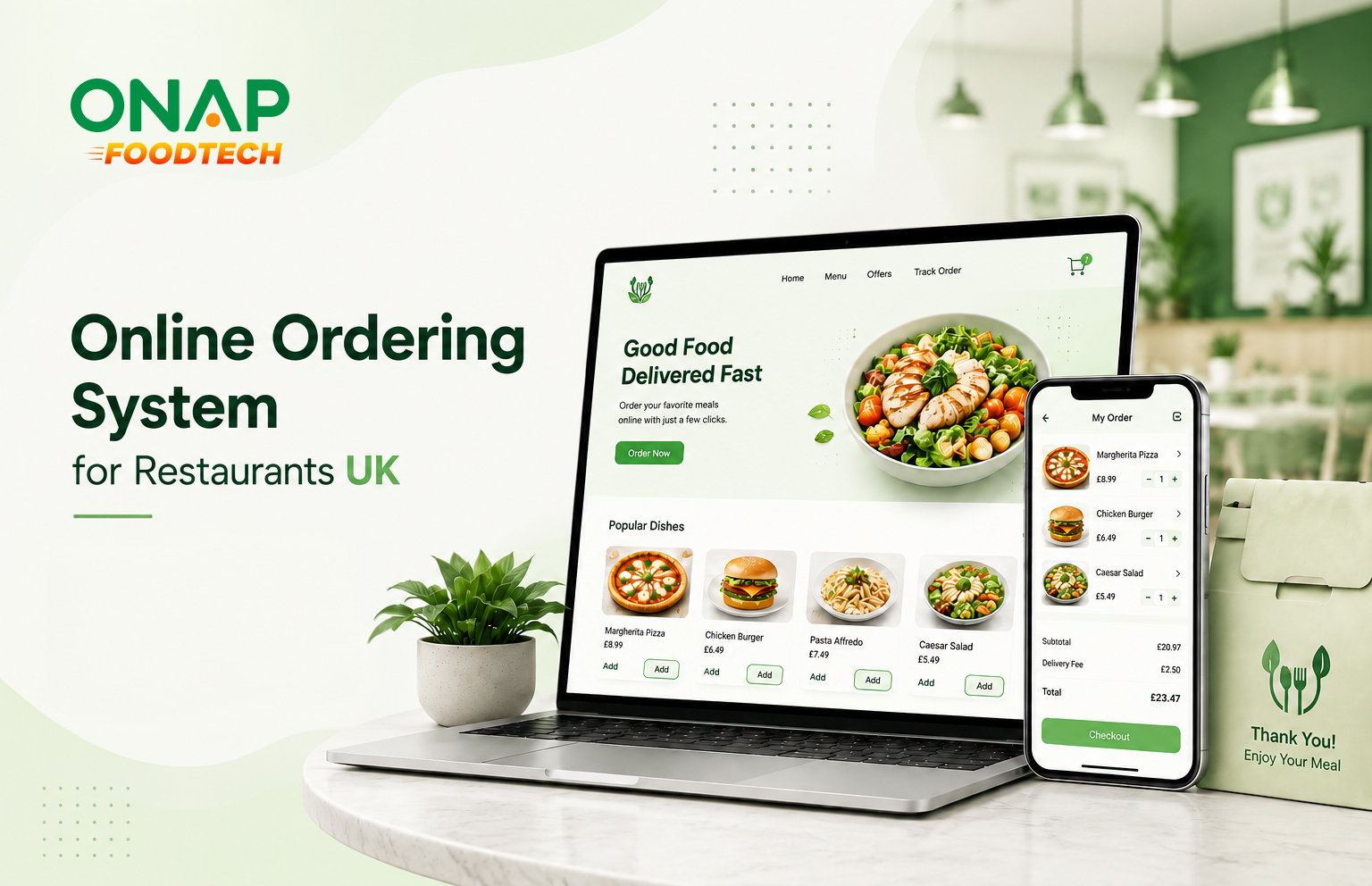
Online food delivery has become an essential revenue stream for restaurants, takeaways, cafés, and dark kitchens across the UK. While marketplaces like Deliveroo, Uber Eats, and Just Eat have helped businesses reach millions of customers, they also come with ongoing commission fees and limited ownership of customer relationships. As order volumes grow, those commissions can take a significant share of every sale. Many restaurant owners eventually reach a point where they ask the same question: should we continue relying entirely on third-party delivery apps, or should we build our own online ordering channel?
For most restaurants, the answer is not choosing one over the other. The strongest businesses use delivery marketplaces to attract new customers while encouraging repeat orders through a commission-free direct ordering system. A branded ordering platform gives restaurants greater control over pricing, promotions, customer data, and the overall ordering experience. It also creates an additional sales channel that continues generating revenue without paying a percentage of every transaction.
This guide explains how direct online ordering works, the advantages it offers UK restaurants, the features worth investing in, and what to consider before choosing a platform.
The Problem With Deliveroo, Uber Eats, and Just Eat Fees
Third-party delivery platforms have transformed the restaurant industry by making online ordering accessible to businesses of every size. They provide visibility, customer acquisition, payment processing, and delivery logistics through a single marketplace. Those benefits come at a cost. Most marketplaces charge commission on every order, often alongside payment processing fees, marketing charges, and optional promotional costs. While the exact pricing depends on the provider and commercial agreement, the cumulative cost can significantly reduce profit margins over time. For independent restaurants operating on already tight margins, this creates several challenges.
Lower Profit Per Order
Every commission paid to a marketplace reduces the amount of revenue retained by the restaurant. For businesses processing hundreds or thousands of orders each month, even a modest percentage can add up to a substantial operating expense.
Limited Customer Ownership
Restaurants often have limited access to customer information when orders are placed through third-party platforms.
This makes it harder to:
- Build loyalty programmes
- Send personalised offers
- Reward repeat customers
- Promote seasonal menus
- Encourage future direct orders
Without direct customer relationships, restaurants remain dependent on the marketplace for repeat business.
Reduced Pricing Flexibility
Some restaurants increase menu prices on delivery platforms to offset commission costs. While understandable, higher prices may discourage customers from ordering or create inconsistencies between dine-in, takeaway, and online pricing.
Increased Marketplace Dependence
A restaurant that receives nearly all online orders from one platform becomes vulnerable to:
- Commission increases
- Policy changes
- Ranking algorithm updates
- Competitive advertising
- Reduced marketplace visibility
Diversifying sales channels reduces this operational risk.
What Is a Direct Online Ordering System?
A direct online ordering system allows customers to place food orders directly with a restaurant through its own website or branded mobile application rather than using a third-party marketplace. Instead of directing customers to another platform, restaurants manage the ordering experience under their own brand.
A typical workflow includes:
- A customer visits the restaurant's website or app.
- They browse the live menu.
- Items are added to the basket.
- Payment is completed securely online.
- The order is sent directly to the restaurant.
- Kitchen staff begin preparation.
- The customer receives order updates until collection or delivery.
The experience feels familiar to customers but provides the restaurant with much greater control over pricing, branding, promotions, and customer engagement. Many direct ordering systems also integrate with restaurant EPOS platforms, kitchen display systems, and delivery management software, reducing manual order entry and improving operational efficiency. Restaurants exploring integrated ordering and restaurant management tools can compare available capabilities on the ONAP FoodTech Features page.
Benefits of Running Your Own Ordering Channel
Launching a direct ordering platform is about more than reducing commissions. It gives restaurants greater control over their business while creating opportunities to improve customer loyalty and operational efficiency.
Higher Profit Margins
When restaurants receive direct orders, they retain more of the revenue from each transaction because ongoing marketplace commissions are reduced or eliminated.
Over time, those savings can be reinvested into:
- Marketing
- Staff training
- Menu development
- Customer rewards
- Business expansion
Stronger Customer Relationships
A direct ordering platform allows restaurants to communicate with customers after the purchase.
This creates opportunities to:
- Send exclusive offers
- Promote new menu items
- Encourage repeat visits
- Reward loyal customers
- Share seasonal promotions
Building long-term customer relationships is considerably easier when orders are placed through your own platform.
Complete Brand Control
Marketplace listings often follow standard layouts with limited branding opportunities.
A branded ordering website allows restaurants to showcase:
- Brand identity
- Photography
- Promotions
- Signature dishes
- Restaurant story
- Special events
The ordering experience becomes an extension of the restaurant rather than another listing inside a marketplace.
Better Business Insights
Because restaurants own their ordering data, they gain valuable insights into customer behaviour.
This information can help answer questions such as:
- Which dishes sell most frequently?
- Which promotions generate repeat orders?
- What are the busiest ordering times?
- Which postcodes generate the most revenue?
- How often do customers return?
These insights support smarter operational and marketing decisions.
Easier Promotion of Loyalty Programmes
Restaurants can integrate loyalty rewards directly into their ordering experience.
Examples include:
- Points for every order
- Birthday rewards
- Referral discounts
- Free delivery promotions
- Exclusive menu launches
Unlike marketplace promotions, these incentives strengthen the restaurant's own customer base. If you're evaluating a platform that combines online ordering with restaurant operations, the ONAP FoodTech platform provides an overview of how ordering, menus, customer management, and operational workflows work together.
Features to Look For in a Restaurant Ordering System
Not every online ordering platform offers the same level of flexibility. Before investing, consider how the software supports both customer experience and day-to-day restaurant operations.
Branded Website and Mobile App
Customers should feel they're ordering directly from your restaurant, not through a generic third-party interface.
A strong ordering platform should include:
- Fully branded ordering website
- Mobile-friendly design
- Optional branded mobile applications
- Custom colours and logos
- Promotional banners
- Multiple locations if required
The ordering journey should remain fast and intuitive across desktop, tablet, and mobile devices.
For restaurants operating in competitive markets such as London, having a recognisable branded ordering experience can also strengthen customer loyalty and encourage repeat purchases.
Menu Management
Menus change frequently.
Seasonal dishes, limited-time offers, ingredient availability, and pricing updates all need to be reflected quickly without relying on developers.
Look for systems that allow restaurants to manage:
- Categories
- Product images
- Descriptions
- Modifier groups
- Meal deals
- Add-ons
- Allergens
- Availability schedules
- Location-specific menus
Real-time menu updates reduce the risk of accepting orders for unavailable items while keeping the customer experience accurate. Integrated menu management also ensures consistency between online ordering, in-store systems, and kitchen operations when connected to an EPOS solution. For businesses comparing modern restaurant technology, it's also worth reading How FoodTech Transforms UK Restaurant Operations to understand how online ordering fits into a broader digital strategy.
Real-Time Order Tracking
Customers expect visibility after placing an order. A confirmation email alone is no longer enough. Real-time order tracking reduces uncertainty by showing each stage of the order, from preparation to dispatch and delivery or collection.
A well-designed ordering system should provide updates such as:
- Order received
- Kitchen preparing the meal
- Ready for collection
- Driver dispatched
- Out for delivery
- Delivered successfully
For restaurant staff, live tracking also improves communication. Instead of answering repeated phone calls asking where an order is, employees can focus on preparing food and serving customers. If the ordering platform integrates with kitchen display systems or delivery management software, status updates can be triggered automatically, reducing manual work and keeping customers informed throughout the journey.
Payment Processing
A smooth checkout experience has a direct impact on completed orders. Customers expect secure, familiar payment options that work across desktop and mobile devices without unnecessary steps.
Look for an ordering platform that supports:
- Debit and credit cards
- Apple Pay
- Google Pay
- Secure online payments
- Collection and delivery payments
- Digital receipts
- Refund management
The checkout process should also be quick. Long forms or unnecessary account creation can increase basket abandonment. Restaurants should ask potential providers whether payment processing is built into the platform or requires a separate payment gateway. Understanding transaction fees alongside subscription costs gives a clearer picture of the total operating cost.
How to Promote Your Direct Ordering Channel to Customers
Launching an online ordering system is only the first step. Customers need a reason to order directly instead of returning to a marketplace. Restaurants that actively promote their own ordering channel often see stronger adoption over time.
Offer Exclusive Rewards
Give customers a benefit that isn't available through delivery apps.
Popular incentives include:
- Percentage discounts on first direct orders
- Free delivery above a minimum spend
- Loyalty points
- Complimentary side dishes
- Exclusive meal bundles
The reward doesn't have to be large. Even a modest incentive can encourage customers to change their ordering habits.
Promote Direct Ordering In-Store
Many loyal customers visit the restaurant regularly but continue using third-party apps at home.
Remind them about your ordering platform through:
- Table talkers
- Window stickers
- QR codes
- Printed receipts
- Takeaway packaging
- Collection counters
These touchpoints reach customers who already know and trust your brand.
Use Email and SMS Marketing
If customers have agreed to receive marketing communications, email and SMS can become valuable channels for encouraging repeat orders.
Examples include:
- New menu launches
- Weekend offers
- Seasonal promotions
- Birthday rewards
- Limited-time discounts
Because the customer relationship belongs to your restaurant, these campaigns help build long-term loyalty rather than driving repeat orders back to a marketplace.
Make Your Website the Primary Destination
Your website should prominently feature online ordering. Avoid making visitors search through multiple pages before finding the ordering button.
The ordering option should be visible:
- On the homepage
- In the main navigation
- On menu pages
- On location pages
- In the website footer
A clear call to action reduces friction and encourages more direct orders.
Promote on Social Media
Restaurants already invest time in social media content. Every post promoting new dishes, events, or special offers should also include a link to the direct ordering page. Customers who discover your restaurant on Instagram or Facebook should have an easy path to ordering without first opening another app.
Can You Run Your Own Ordering Alongside Deliveroo?
Yes, and for many UK restaurants, this is the most practical strategy. Direct ordering and delivery marketplaces serve different purposes. Marketplaces help restaurants reach customers who have never heard of the business before. A branded ordering platform helps convert those first-time customers into repeat customers who order directly in the future.
A balanced approach often looks like this:
| Delivery Marketplace | Direct Ordering Platform |
|---|---|
| Customer acquisition | Customer retention |
| Marketplace visibility | Brand ownership |
| Commission per order | Greater revenue retention |
| Shared customer relationship | Direct customer relationship |
| Marketplace promotions | Restaurant-controlled promotions |
This strategy allows restaurants to continue benefiting from the reach of Deliveroo, Uber Eats, and Just Eat while gradually increasing the percentage of commission-free orders. The goal is not necessarily to leave delivery marketplaces altogether. Instead, it's to reduce dependence on them over time. Restaurants comparing integrated ordering solutions can also explore the ONAP FoodTech platform, which combines online ordering with restaurant management capabilities.
How Much Does a Direct Online Ordering System Cost in the UK?
There is no single pricing model for restaurant ordering software.
Providers may charge through:
- Monthly subscriptions
- Setup fees
- Transaction fees
- Payment processing charges
- Optional branded mobile apps
- Additional users
- Premium support
- Advanced integrations
When comparing platforms, focus on the total cost of ownership rather than the headline monthly price.
Questions to Ask Before Comparing Costs
Ask every provider:
- Is there a setup fee?
- Are software updates included?
- Are mobile apps included or optional?
- Does pricing change as order volume grows?
- Are integrations charged separately?
- Is customer support included?
- Are menu updates unlimited?
- Can multiple restaurant locations be managed from one account?
A platform with a slightly higher subscription cost may prove more cost-effective if it includes features that would otherwise require additional services. Restaurants evaluating available plans can compare what's included on the ONAP FoodTech Pricing page.
Consider the Return on Investment
The value of a direct ordering system shouldn't be measured only by software costs.
Consider broader operational benefits such as:
- Lower commission expenses
- More repeat customers
- Better customer data
- Increased average order value through upselling
- Reduced manual order entry
- Faster service
- Improved brand recognition
Frequently Asked Questions
Is an online ordering system suitable for small independent restaurants?
Yes. Independent restaurants, cafés, takeaways, and food trucks can all benefit from direct ordering. Even a modest number of commission-free orders each week can improve margins while helping build stronger relationships with repeat customers.
Can I keep using Deliveroo, Uber Eats, and Just Eat?
Yes. Many restaurants continue using marketplace apps for customer acquisition while encouraging returning customers to order directly through their own website or app. This approach helps diversify revenue without relying on a single sales channel.
Do I need a mobile app as well as a website?
Not always. A mobile-friendly ordering website is enough for many restaurants, especially during the early stages. A branded mobile app becomes more valuable as repeat orders increase and customer loyalty programmes become a larger part of the business.
Can customers schedule orders in advance?
Most online ordering systems support scheduled collection and delivery times. This allows customers to place orders earlier in the day while helping restaurants manage kitchen capacity more efficiently.
Will an online ordering system work with my existing EPOS?
Many platforms integrate with popular restaurant EPOS solutions, allowing orders to flow directly into kitchen operations. Before purchasing, confirm that the software supports your current hardware and operational workflow.
What should I prioritise when choosing a provider?
Focus on reliability, ease of use, menu management, payment options, customer ownership, integrations, scalability, and transparent pricing. A platform should simplify daily operations while supporting the long-term growth of your restaurant.
Conclusion
A direct online ordering system gives restaurants far more than another way to accept orders. It creates an owned sales channel where you control the customer experience, retain more revenue, and build lasting relationships with diners. Delivery marketplaces will continue to play an important role in helping restaurants reach new customers. The businesses that perform best over time are often those that balance marketplace visibility with a strong direct ordering strategy. When evaluating platforms, look beyond the monthly subscription. Consider how the software handles menu management, customer communication, integrations, reporting, payment processing, and future expansion. A solution that supports your business as it grows will deliver value long after the initial setup is complete.
Explore More Blogs
Discover more expert insights, software guides, and industry best practices to help your business grow with ONAP.
How to Launch a Branded Restaurant App Without a Developer (UK Guide 2026)
Launching a branded restaurant app no longer requires an in-house development team. This 2026 UK guide explains how restaurant owners can choose a no-code or managed app platform, connect ordering and payments, build loyalty features, publish the app, and avoid the common mistakes that make app projects expensive.
Field Service Engineer Scheduling Software UK: Free vs Paid Options Compared
Field service engineer scheduling software helps UK contractors assign jobs, manage availability, track engineers and keep customers updated. This guide compares free scheduling tools, spreadsheets and paid field service platforms, including their features, limitations, costs and suitability for growing teams.
Café vs Cloud Kitchen vs Dark Kitchen: Which Model Works Best for UK Food Businesses
Cafés, cloud kitchens and dark kitchens each suit different UK food businesses. This guide compares premises, staffing, startup costs, delivery economics, customer acquisition, technology, VAT and growth potential, helping operators choose the model that fits their menu, target market and available capital.