Gas Safety Certificate Software UK: How to Manage CP12 Certificates Digitally
Discover how gas safety certificate software helps UK heating engineers, landlords, and property maintenance businesses manage CP12 certificates digitally. Learn how digital records, automated reminders, mobile inspections, and compliance tools reduce paperwork, improve efficiency, and support Gas Safe compliance across single and multi-property portfolios.
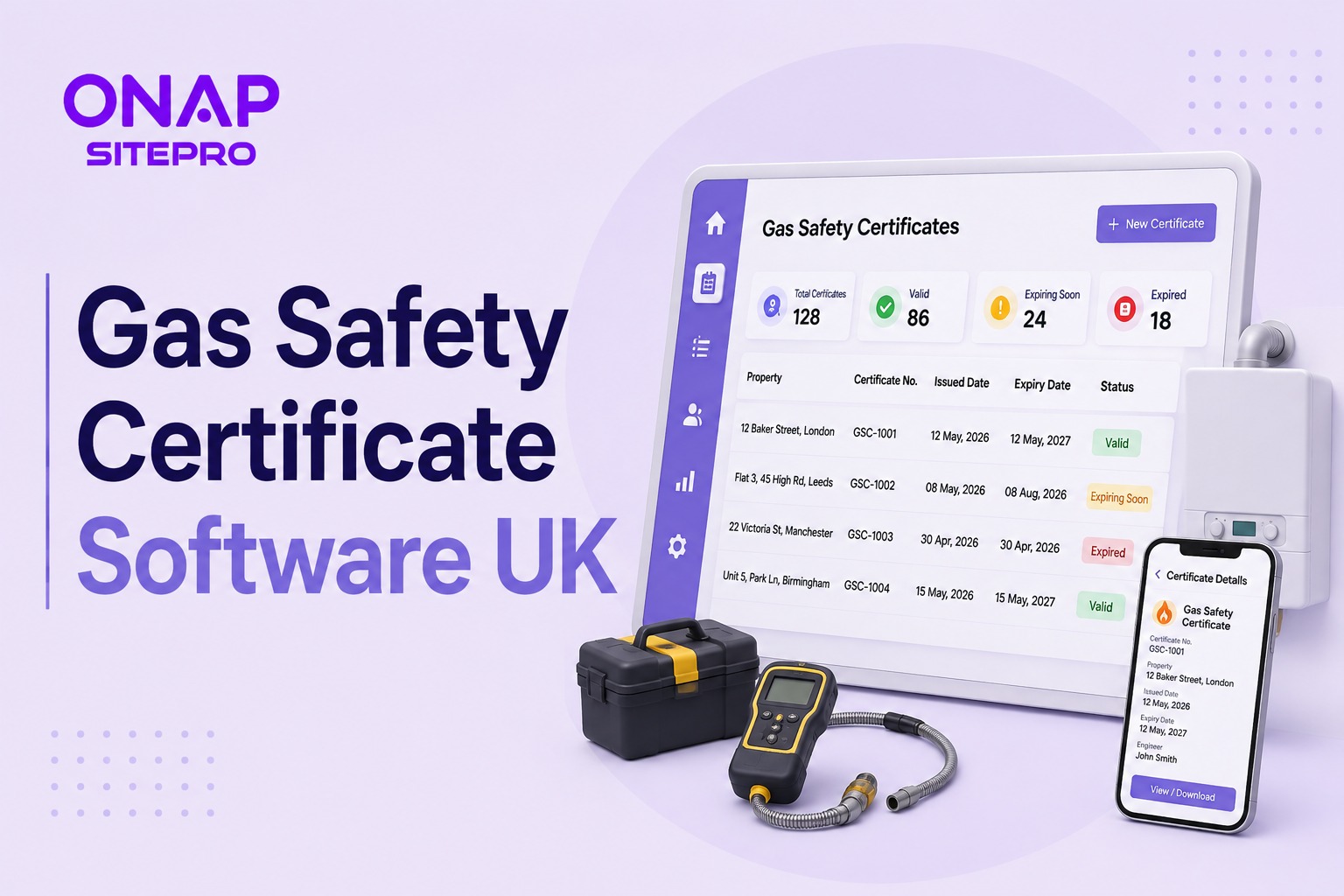
Gas safety certificate software helps UK businesses create, store, manage, and renew CP12 certificates digitally. Instead of relying on paper forms, spreadsheets, or disconnected filing systems, engineers can complete inspections on-site, generate compliant certificates, schedule future inspections, and keep a secure digital record of every property. For many gas engineers, missing a renewal date is not caused by poor workmanship. It happens because reminders are scattered across diaries, emails, and filing cabinets. As property portfolios grow, manual administration becomes one of the biggest operational risks. Digital certificate management addresses that problem while making everyday work faster. According to the Gas Safe Register, landlords must ensure gas appliances receive an annual safety check by a Gas Safe registered engineer. The Health and Safety Executive (HSE) also places clear legal duties on those responsible for gas installations. Meeting those obligations becomes much easier when inspection records are organised in one central system.
\nUnderstanding CP12 Certificates and Legal Responsibilities
\nA CP12, often referred to as a Gas Safety Certificate, documents the results of an annual fire safety inspection carried out by a Gas Safe registered engineer.
\nThe certificate typically includes:
\n- \n
- Property details \n
- Appliance information \n
- Flue inspection results \n
- Safety observations \n
- Defects identified \n
- Remedial work recommendations \n
- Engineer registration details \n
- Inspection date \n
- Next inspection due date \n
For landlords, letting agents, housing associations and facilities management companies, keeping these certificates organised is as important as carrying out the inspection itself. The practical reality is that compliance failures usually begin with administration rather than engineering.
\n\n
Why Paper CP12 Certificates Create Problems
\nMany independent engineers still complete inspections using paper forms before typing certificates into office software later. That approach creates unnecessary work.
\nCommon issues include:
\n- \n
- Lost paperwork \n
- Duplicate data entry \n
- Missing renewal dates \n
- Delayed certificate delivery \n
- Difficulty locating historic inspections \n
- Limited visibility across multiple engineers \n
Consider a plumbing and heating company managing 1,200 landlord properties. Each property requires annual inspections. Without automated reminders, even a small administrative mistake could lead to missed appointments, emergency rescheduling and frustrated customers. Digital systems reduce those risks considerably.
\nWhat Gas Safety Certificate Software Does
\nGas safety certificate software combines compliance documentation with job management. Instead of treating certificates as standalone documents, modern platforms connect inspections with scheduling, customer records, recurring maintenance contracts and engineer workflows.
\nA typical process looks like this:
\n| Traditional Process | \nDigital Process | \n
|---|---|
| Paper inspection forms | \nMobile inspection forms | \n
| Manual diary reminders | \nAutomatic renewal reminders | \n
| Office data entry | \nEngineer completes certificate onsite | \n
| Separate filing system | \nCloud document storage | \n
| Email attachments | \nInstant customer delivery | \n
| Spreadsheet tracking | \nLive compliance dashboard | \n
This connected workflow saves time while reducing administrative mistakes.
\nCore Features to Look For
\nDifferent software platforms target different markets. Some focus only on digital forms, while others include complete field service management. The following features provide the greatest operational value.
\nDigital CP12 Certificate Creation
\nEngineers should be able to complete inspections directly from a mobile phone or tablet. Mandatory fields reduce missing information. Digital signatures remove the need for printed paperwork. Once completed, certificates can be emailed immediately. Customers appreciate receiving documentation before the engineer leaves site.
\nAutomatic Renewal Reminders
\nAnnual inspections repeat every twelve months. Missing renewal dates affects customer confidence and recurring revenue. Good software automatically reminds both office staff and customers before certificates expire. Most operators find recurring reminders generate repeat business without manual follow-up.
\nProperty History
\nEvery property develops its own maintenance history. Previous appliance replacements, advisory notes and repair work become valuable during future inspections. Instead of searching through folders, engineers can view complete service records within seconds.
\nMobile Access
\nMany inspections take place where mobile signal is inconsistent. Offline capability allows engineers to continue working before synchronising data once internet access returns. This matters for rural properties, plant rooms and commercial sites.
\nCompliance Dashboard
\nOffice teams benefit from seeing upcoming renewals across every property.
\nA dashboard typically highlights:
\n- \n
- Certificates due this month \n
- Overdue inspections \n
- Completed visits \n
- Outstanding remedial work \n
- Engineer workloads \n
That visibility makes planning much easier.
\nDigital Certificates vs PDF Templates
\nMany engineers believe using editable PDF forms counts as digital compliance. The honest answer is that PDFs solve only part of the problem.
\n| PDF Forms | \nGas Safety Certificate Software | \n
|---|---|
| Manual storage | \nCentral cloud storage | \n
| Manual reminders | \nAutomatic reminders | \n
| Separate customer database | \nIntegrated CRM | \n
| Individual documents | \nProperty history | \n
| No scheduling | \nJob scheduling included | \n
| Limited reporting | \nCompliance dashboards | \n
PDF templates reduce handwriting. Software manages the entire compliance process.
\nBenefits for Different Types of Businesses
\nDifferent organisations gain value in different ways.
\nIndependent Gas Engineers
\nSolo engineers spend less time on administration. Digital certificates also present a more professional experience for customers.
\nLetting Agents
\nManaging hundreds of landlord properties becomes much easier when every certificate is searchable. Automatic reminders reduce the likelihood of missed renewals.
\nFacilities Management Companies
\nFacilities managers often oversee mixed portfolios containing offices, schools, healthcare buildings and residential properties. Digital systems centralise compliance records across multiple engineers and contractors. Businesses already reviewing dedicated Facilities Management Software often look for integrated CP12 management rather than standalone certificate apps.
\nHousing Associations
\nLarge housing providers require audit trails for thousands of annual inspections. Central reporting makes regulatory reporting significantly easier than spreadsheet-based tracking.
\nConnecting CP12 Management With Job Management
\nGas safety inspections rarely exist in isolation.
\nA routine inspection often identifies additional work such as:
\n- \n
- Boiler servicing \n
- Appliance replacement \n
- Radiator repairs \n
- Flue repairs \n
- Landlord maintenance work \n
When certificate software connects with job management software, follow-on work can be quoted and scheduled immediately. This reduces duplicate administration and keeps customer records complete. Businesses exploring broader operational software can compare this alongside a dedicated guide to Work Order Management Software.
\nChoosing the Right Software for a UK Business
\nNot every business requires an enterprise platform. Selection depends on workload, team size and customer base. Consider these questions before purchasing.
\nHow many inspections are completed each month?
\nBusinesses completing dozens of certificates each week benefit most from automation.
\nDoes the software support recurring jobs?
\nAnnual inspections should generate automatically. Manual scheduling wastes office time.
\nCan engineers work from mobile devices?
\nPaper forms create delays. Mobile workflows reduce administration significantly.
\nDoes it integrate with invoicing?
\nConnecting certificates with invoices prevents duplicate customer records.
\nIs document storage secure?
\nCompliance records should remain accessible for future inspections and audits.
\nCommon Buying Mistakes
\nMany buyers focus entirely on certificate templates. That often creates problems later.
\nFrequent mistakes include:
\n- \n
- Choosing software without recurring scheduling \n
- Ignoring mobile usability \n
- Overlooking reporting capabilities \n
- Not considering future business growth \n
- Buying separate systems for jobs, certificates and customers \n
Most growing businesses eventually prefer one connected platform over multiple standalone tools.
\nImplementation Is Usually Faster Than Expected
\nMoving from paper records does not require months of planning. Smaller businesses often complete implementation over a few days.
\nThe process usually involves:
\n- \n
- Import customer records. \n
- Add property information. \n
- Configure certificate templates. \n
- Train engineers. \n
- Schedule recurring inspections. \n
- Begin issuing digital certificates. \n
Companies already using field service software generally experience even faster adoption because engineers are familiar with mobile workflows. For organisations reviewing wider operational tools, the guide to Field Service Management Software UK explains how certificate management fits into a complete service platform.
\nWhere SitePro Fits
\nBusinesses that manage recurring compliance work often prefer software that combines scheduling, work orders, customer records, quotations, invoicing and documentation instead of separate applications. For gas engineers and maintenance companies, SitePro forms part of the wider ONAP platform and brings these operational tools together in one system. Features such as job scheduling, digital work orders, engineer mobile access and document management help reduce administration while keeping compliance records organised. Businesses wanting a broader overview can explore the available SitePro features before deciding whether an integrated platform suits their operation.
\nFrequently Asked Questions
\nWhat is gas safety certificate software?
\nGas safety certificate software is a digital system that helps engineers create, store and manage CP12 certificates while tracking inspection schedules, customer records and future renewals.
\nCan CP12 certificates be completed digitally?
\nYes. Many software platforms allow engineers to complete certificates on tablets or smartphones, collect digital signatures and email completed documents directly to customers.
\nIs digital storage acceptable for Gas Safe records?
\nDigital storage is commonly used across the industry provided records remain secure, accessible and accurate. Businesses should always ensure they meet current legal and regulatory requirements.
\nDoes CP12 software send renewal reminders?
\nMost modern systems include automatic reminders for upcoming annual inspections, helping landlords and contractors avoid expired certificates.
\nCan small plumbing businesses benefit from certificate software?
\nYes. Even a sole trader managing a few hundred landlord inspections each year can reduce paperwork, improve organisation and deliver certificates faster using digital software.
\nConclusion
\nCertificate software focuses on compliance documentation. Field service management software combines certificates with scheduling, quoting, invoicing, work orders, customer management and reporting, making it a better fit for growing businesses. Managing CP12 certificates digitally is no longer just about reducing paperwork. It improves compliance, shortens administrative tasks, keeps engineers productive in the field and gives customers a faster, more professional experience.
\nFor businesses carrying out recurring gas inspections alongside fire safety, planned maintenance or wider compliance work, adopting a single operational platform often delivers greater long-term value than using standalone certificate tools. If your business also manages fire risk assessments, alarms or emergency lighting, our guide to Fire Safety Management Software. explains how integrated job management can support both compliance and day-to-day operations. Businesses handling recurring inspections should look beyond digital forms alone and consider how certificate management fits into their wider operational workflow.
Explore More Blogs
Discover more expert insights, software guides, and industry best practices to help your business grow with ONAP.

Epos Now vs ONAP FoodTech: UK Restaurant Software Compared 2026
Epos Now vs ONAP FoodTech compared on EPOS hardware, online ordering, CRM, loyalty and marketing automation for UK restaurants in 2026.
Oracle Field Service vs ONAP SitePro: UK Field Service Software Compared 2026
Oracle Field Service vs ONAP SitePro compared on deployment, contracts, pricing and included features for UK field service teams in 2026.
Oracle Food & Beverage vs ONAP FoodTech: UK Restaurant Software Compared 2026
Oracle Food & Beverage vs ONAP FoodTech compared on deployment, contracts, pricing and included features for UK restaurants in 2026.