WhatsApp Marketing for UK Restaurants: How to Get 40% More Repeat Orders
Learn how UK restaurants can use WhatsApp marketing to increase repeat orders, reduce reliance on third-party delivery platforms and build stronger customer relationships. This guide covers compliant customer data collection, campaign ideas, direct ordering, automation, loyalty offers, measurement and the practical features restaurant operators should look for in a WhatsApp marketing platform.
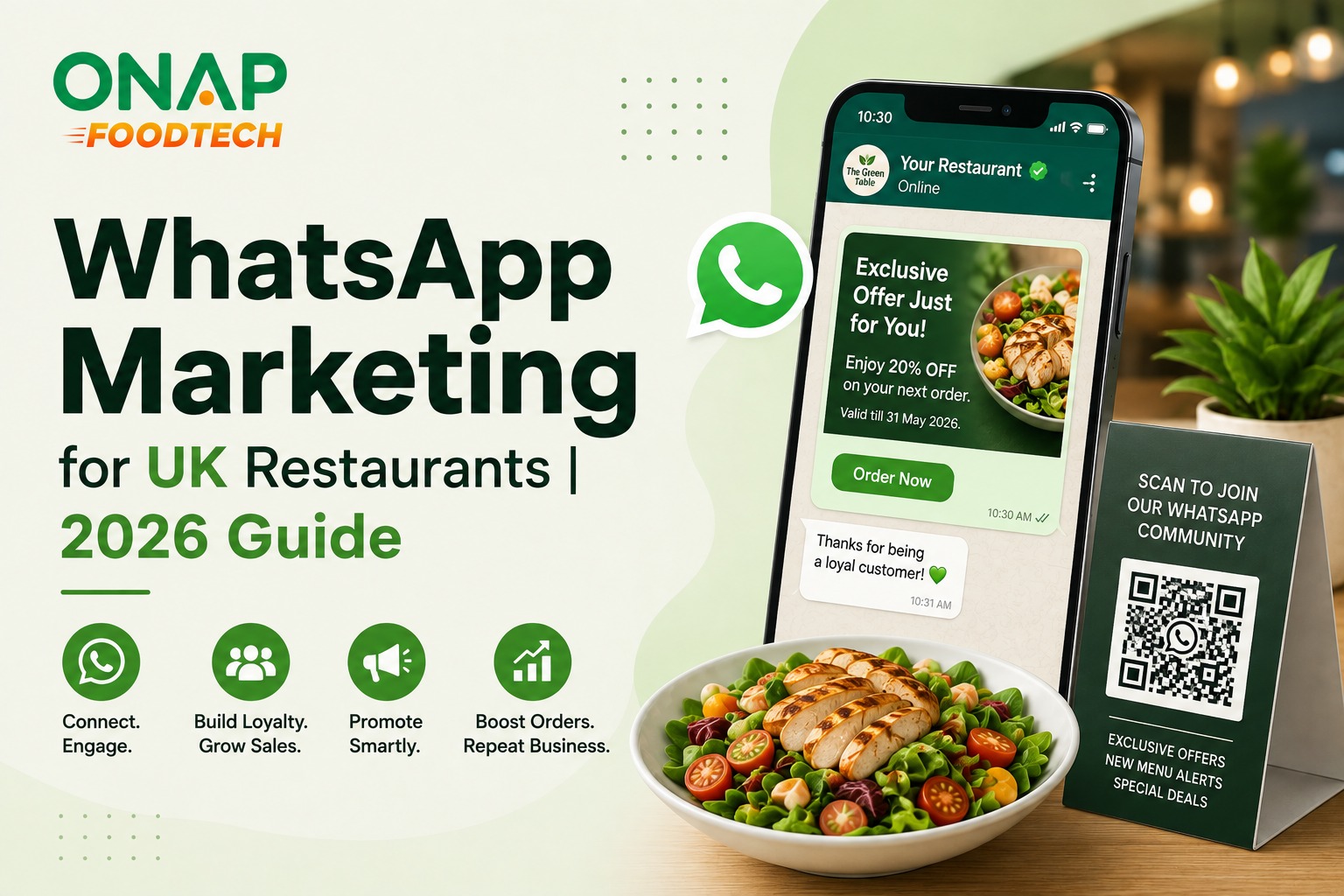
Table of Contents
- Why WhatsApp marketing works for restaurant repeat orders
- How to build a WhatsApp restaurant marketing strategy
- WhatsApp marketing versus email and SMS
- Direct WhatsApp ordering can protect restaurant margins
- What restaurant WhatsApp software should include
- WhatsApp marketing mistakes that cost restaurants sales
- How to measure WhatsApp restaurant marketing
- How FoodTech can support WhatsApp-driven retention
- Is WhatsApp marketing worth it for UK restaurants?
- Frequently Asked Questions
- Is WhatsApp marketing legal for UK restaurants?
- Can WhatsApp increase restaurant repeat orders?
- How often should a restaurant send WhatsApp marketing messages?
- Can WhatsApp drive direct restaurant orders?
- Should restaurants use WhatsApp or email marketing?
- What should restaurants measure from WhatsApp campaigns?
- Build WhatsApp marketing around repeat customers
WhatsApp marketing for UK restaurants is the use of WhatsApp to communicate with customers, promote offers, encourage repeat visits and drive direct orders. A 40% increase in repeat orders should be treated as a campaign target, not a guaranteed result. With more than 2 billion people using WhatsApp every day, the channel gives restaurants a direct route back to customers who have already ordered.
For a restaurant, that distinction matters. Getting a customer to order once is only half the job. The profitable relationship starts when that customer comes back without needing another expensive acquisition campaign. A restaurant in Manchester, for example, might have hundreds of customers who ordered takeaway during the previous three months. If those diners remain trapped inside an aggregator's ecosystem, the restaurant has limited control over how and when it reaches them. WhatsApp can create a direct communication channel, provided the restaurant has collected permission to market to those customers.
Why WhatsApp marketing works for restaurant repeat orders
WhatsApp marketing works particularly well for restaurants because the buying cycle is short. Customers may decide what to eat tonight, tomorrow or this weekend. A useful message arriving at the right moment can therefore have a much shorter path to purchase than a traditional promotional email. Meta says more than two billion people use WhatsApp every day and millions already communicate with businesses through the platform. Meta has also introduced controls intended to limit unwanted business messages, including limits on the number of marketing messages people can receive.
That creates both an opportunity and a warning. Customers are willing to interact with businesses on WhatsApp, but they do not want an inbox filled with discount codes. Restaurants need to earn attention by sending messages that have a clear reason to be opened.
A useful restaurant campaign might include:
- A personalised offer for customers who have not ordered recently
- A reminder about a popular weekend menu
- A limited-time collection offer
- A loyalty reward
- A new menu announcement
- A direct ordering link
- A birthday or customer anniversary offer
- A message based on previous ordering behaviour
The objective is not to message everyone every Friday. It is to give the right customer a relevant reason to order again.
How to build a WhatsApp restaurant marketing strategy
A successful WhatsApp restaurant marketing strategy starts with the customer database, not the message template. Before sending campaigns, separate customers into useful groups. A restaurant could have recent customers, inactive customers, high-value customers, frequent takeaway customers and customers who normally order at weekends.
This makes a major difference to the message. Someone who ordered twice last week does not need the same incentive as someone who has not ordered for three months. Sending both customers the same 20% discount may waste margin on the first group while failing to motivate the second.
Start with first-party customer data
Your customer list should ideally contain useful information such as:
| Customer information | Potential marketing use |
|---|---|
| Last order date | Win-back campaign |
| Order frequency | Loyalty messaging |
| Average order value | Higher-value offers |
| Favourite products | Personalised recommendations |
| Collection or delivery preference | Relevant ordering message |
| Location | Local promotions |
| Marketing consent | Campaign eligibility |
The quality of this information matters more than the size of the database. A list of 1,500 customers with useful order history can be more valuable than 15,000 contacts with no purchasing context.
Create a clear opt-in process
UK restaurants need to treat WhatsApp marketing as direct electronic marketing, not casual customer communication. The Information Commissioner's Office says direct marketing through electronic messages can fall under PECR, and businesses will often need specific consent when sending unsolicited marketing to individuals. The ICO also says businesses should provide a way for recipients to opt out and act on those requests promptly.
For restaurants, consent can be requested during online ordering, loyalty registration or another customer sign-up process. The wording should make the purpose clear. Customers should understand that they are agreeing to receive marketing messages, rather than assuming that giving a phone number for delivery automatically means marketing permission. Keep consent records. That becomes particularly important as your database grows and multiple staff members begin running campaigns.
WhatsApp marketing versus email and SMS
WhatsApp should not automatically replace every other marketing channel.
Each channel has a different role.
| Channel | Best use | Main strength | Main limitation |
|---|---|---|---|
| Repeat orders and direct conversations | Immediate, familiar messaging | Requires careful frequency management | |
| Menus, newsletters and longer promotions | More space for content | Lower urgency | |
| SMS | Short reminders and urgent offers | Direct and concise | Message costs and limited space |
| Push notifications | App-based loyalty | Strong for app users | Requires an installed app |
| Social media | Discovery and brand awareness | Broad reach | Less control over audience |
For many restaurants, WhatsApp works best as part of a wider customer retention strategy. A customer might discover a restaurant through Instagram, place the first order through an online ordering system, join the loyalty programme and later receive a WhatsApp reminder about a relevant offer. That journey creates more opportunities for the restaurant to bring the customer back.
Direct WhatsApp ordering can protect restaurant margins
The strongest reason to connect WhatsApp marketing with direct ordering is financial control. Third-party delivery platforms can be useful for discovery and incremental demand, but restaurants do not own the customer relationship in the same way they do with a direct customer database.
A repeat customer who already knows your restaurant is a different proposition from a first-time customer searching a marketplace. The restaurant can use WhatsApp to bring that existing customer back to its own ordering channel.
For example:
- Customer places a first order through an external platform.
- Restaurant encourages the customer to join its own loyalty programme through an appropriate consent mechanism.
- Customer opts into marketing.
- Restaurant sends a relevant WhatsApp campaign later.
- Customer follows the direct ordering link.
- Restaurant records the order in its own customer database.
- Future campaigns become more personalised.
The economics depend on delivery costs, payment processing, discounts and the restaurant's own technology stack. The point is not that every direct order is automatically more profitable. The point is that the restaurant gains more control over the customer relationship. For businesses building a stronger direct channel, an online ordering system for UK restaurants can sit alongside WhatsApp campaigns and loyalty activity.
What restaurant WhatsApp software should include
Choosing software requires more than checking whether it can send WhatsApp messages. The useful question is whether it connects messaging with the rest of the restaurant operation.
Look for:
- Customer database management
- Marketing consent records
- Customer segmentation
- Automated campaigns
- Direct ordering links
- Loyalty programme integration
- Order history
- Campaign reporting
- Customer profiles
- EPOS or ordering integrations
- API access where required
- Multi-location management
- Staff permissions
- Opt-out management
The connection between these systems is where the commercial value sits.
A WhatsApp tool that knows nothing about a customer's order history is little more than a broadcast system. A restaurant platform that combines customer data, loyalty, ordering and marketing can support more targeted campaigns. For restaurants considering a wider technology setup, FoodTech restaurant management software brings online ordering, CRM, loyalty, marketing automation and analytics into the same operating environment.
WhatsApp marketing mistakes that cost restaurants sales
The biggest mistake is sending too many messages. Meta has introduced limits around marketing messages because unwanted communication can damage the customer experience. Businesses using the WhatsApp Business Platform also face template review and policy controls. Other common mistakes include:
Sending the same offer to everyone
A customer who orders every week does not necessarily need another 20% discount. Use purchase behaviour to decide who receives an incentive.
Making the message too long
Restaurant marketing needs to work on a mobile screen. Lead with the reason to order, show the offer and give customers a clear next step.
Sending messages without consent
A phone number collected for delivery is not automatically a marketing permission slip. Review your consent process before launching a campaign.
Ignoring opt-outs
An unsubscribe request should be treated as a customer preference, not an inconvenience. The ICO advises businesses to maintain a do-not-contact list and screen marketing activity against it.
Measuring clicks instead of orders
A campaign can generate plenty of link clicks and still produce weak commercial results. Restaurant operators should connect campaign activity to completed orders and revenue wherever possible.
How to measure WhatsApp restaurant marketing
A simple reporting dashboard can show whether the channel is producing incremental business. Start with five core measurements:
Repeat-order rate: The percentage of customers who place another order within a defined period.
WhatsApp-attributed orders: Orders linked to a campaign or WhatsApp interaction.
Revenue per campaign: Sales generated compared with the cost of the campaign and incentives.
Average order value: Whether WhatsApp customers spend more or less than other direct-order customers.
Opt-out rate: A useful indicator of message relevance and frequency.
You can also track customer lifetime value over time. Imagine a customer who normally orders twice a month and spends £28 per order. A targeted campaign that keeps that customer active for another six months has a different value from a one-off £5 discount redemption. The strongest restaurant marketing teams therefore measure retention, not just campaign activity.
How FoodTech can support WhatsApp-driven retention
WhatsApp marketing works best when customer conversations connect with ordering and retention data. ONAP's FoodTech platform is designed around restaurant operations including online ordering, CRM, loyalty, marketing automation and analytics. Restaurants looking at the wider system can review the FoodTech feature set to see how customer retention activity can sit alongside ordering and restaurant management.
The value is operational rather than cosmetic. A marketing message should lead somewhere. If the customer receives a WhatsApp offer but then has to search Google, open a delivery marketplace and find the restaurant again, much of the benefit disappears. A direct route from message to order creates a cleaner journey. For a restaurant group, the same principle applies across locations. Customer data, campaigns and reporting should be consistent while each branch can still promote relevant local offers.
Is WhatsApp marketing worth it for UK restaurants?
WhatsApp marketing is worth considering when a restaurant already has repeat customers and a clear way to collect marketing permission. It is less useful as a standalone replacement for customer acquisition. A new restaurant with no customer database still needs discovery through search, social media, partnerships, advertising and other channels.
The strongest use case is the middle of the customer journey. You have already paid to acquire the customer. They have tried the food. Now you need to give them a reason to return. That is where messaging can become valuable. Meta's own data shows the scale of business communication on WhatsApp. In 2026, Meta said paid WhatsApp messaging had passed a $2 billion annual run-rate in the fourth quarter of 2025, reflecting the growing commercial role of business messaging.
Restaurants should still judge the channel on their own numbers. If WhatsApp produces more repeat orders, stronger direct-order revenue and acceptable customer retention costs, increase investment. If customers unsubscribe or campaigns depend on heavy discounting, change the strategy before increasing message volume.
Frequently Asked Questions
Is WhatsApp marketing legal for UK restaurants?
Yes, restaurants can use WhatsApp for marketing in the UK, but they must follow applicable direct marketing and data protection rules. The ICO states that direct marketing through electronic messages can be subject to PECR, with consent often required for unsolicited marketing to individuals. Restaurants should record permission, identify themselves, provide an opt-out and maintain appropriate suppression records.
Can WhatsApp increase restaurant repeat orders?
WhatsApp can help increase repeat orders, but there is no universal percentage that applies to every restaurant. Results depend on the size and quality of the customer database, campaign timing, offer strength, ordering experience and customer frequency. A 40% increase should therefore be treated as a measurable campaign target rather than a guaranteed WhatsApp benchmark.
How often should a restaurant send WhatsApp marketing messages?
Restaurants should send WhatsApp marketing messages only when there is a useful reason to contact the customer. Weekly promotional messages may work for some audiences but cause unsubscribes for others. Monitor read rates, orders and opt-outs to find a suitable frequency. Meta also limits marketing message volume to help reduce unwanted business communication.
Can WhatsApp drive direct restaurant orders?
Yes, WhatsApp can send customers directly to a restaurant's online ordering journey. This is particularly useful for existing customers who already know the brand and need a convenient reason to order again. The strongest setup connects WhatsApp campaigns with customer data, loyalty and direct ordering, allowing restaurants to measure which messages lead to completed purchases.
Should restaurants use WhatsApp or email marketing?
Restaurants can use both because they serve different purposes. WhatsApp is suited to short, timely messages and direct customer conversations, while email gives restaurants more room for menus, newsletters and longer promotional content. The best choice depends on customer preferences and campaign goals. A combined strategy can give restaurants more opportunities to bring existing customers back.
What should restaurants measure from WhatsApp campaigns?
Restaurants should measure repeat orders, WhatsApp-attributed revenue, average order value, redemption rates, campaign costs and opt-outs. Clicks and read rates can help explain campaign behaviour, but completed orders are the stronger commercial measure. Comparing campaign performance with a historical baseline also helps determine whether WhatsApp is generating incremental demand or merely shifting customers between ordering channels.
Build WhatsApp marketing around repeat customers
WhatsApp gives UK restaurants a direct communication channel, but the technology alone will not produce a 40% increase in repeat orders. The result comes from combining permission-based customer data, useful messages, sensible frequency, direct ordering and careful measurement. Start with one customer segment rather than the entire database. Test a win-back campaign, track completed orders and compare the result with your existing repeat-order rate. Then expand the campaigns that produce profitable behaviour.
For restaurants already investing in online ordering and customer retention, WhatsApp can become another part of the same system rather than another disconnected marketing task. The goal is straightforward: give existing customers a good reason to order again, make the path to purchase short, and measure what happens afterwards. Meta's business messaging direction also suggests that WhatsApp will continue becoming a more important commercial channel. The company reported that more than one billion active threads with businesses take place across WhatsApp, Messenger and Instagram each day, showing how much customer communication now happens through messaging.
For a UK restaurant, the sensible next step is to establish the baseline first, build a compliant opt-in audience, then test one campaign at a time. That gives the 40% target a proper business context and lets actual order data decide what works.
Explore More Blogs
Discover more expert insights, software guides, and industry best practices to help your business grow with ONAP.
How to Launch a Branded Restaurant App Without a Developer (UK Guide 2026)
Launching a branded restaurant app no longer requires an in-house development team. This 2026 UK guide explains how restaurant owners can choose a no-code or managed app platform, connect ordering and payments, build loyalty features, publish the app, and avoid the common mistakes that make app projects expensive.
Field Service Engineer Scheduling Software UK: Free vs Paid Options Compared
Field service engineer scheduling software helps UK contractors assign jobs, manage availability, track engineers and keep customers updated. This guide compares free scheduling tools, spreadsheets and paid field service platforms, including their features, limitations, costs and suitability for growing teams.
Café vs Cloud Kitchen vs Dark Kitchen: Which Model Works Best for UK Food Businesses
Cafés, cloud kitchens and dark kitchens each suit different UK food businesses. This guide compares premises, staffing, startup costs, delivery economics, customer acquisition, technology, VAT and growth potential, helping operators choose the model that fits their menu, target market and available capital.