Restaurant Loyalty Programme Software UK: Complete Buyer's Guide (2026)
Discover how restaurant loyalty programe software works, which features matter most, how to compare leading solutions, and what UK restaurants should consider before investing. This guide explains customer retention strategies, implementation tips, integration requirements, and how to choose software that increases repeat visits and long-term revenue.
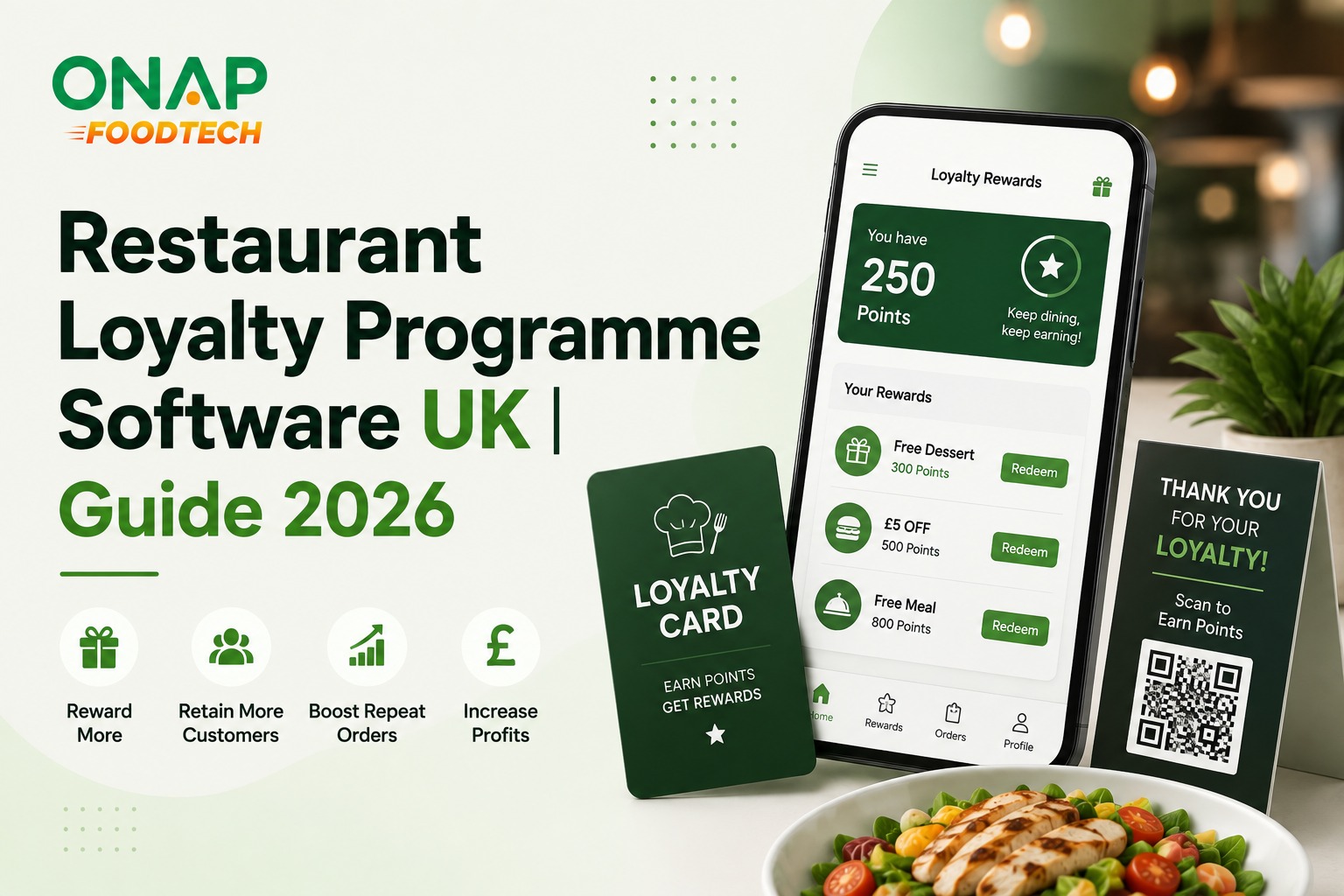
Table of Contents
- Why Restaurant Loyalty Programmes Matter More Than Ever
- How Restaurant Loyalty Programme Software Works
- Common Types of Restaurant Loyalty Programmes
- Features to Look for in Restaurant Loyalty Programme Software
- Choosing the Right Restaurant Loyalty Programme Software
- Comparing Different Types of Loyalty Solutions
- Common Mistakes Restaurants Make
- Implementation Tips for UK Restaurants
- How ONAP FoodTech Supports Restaurant Loyalty
- FAQ
- What is the best restaurant loyalty programme software for UK restaurants?
- Can loyalty software work with my existing EPOS system?
- How much does restaurant loyalty software cost in the UK?
- Is a digital loyalty programme better than paper stamp cards?
- How long does it take to implement restaurant loyalty software?
- Can loyalty software increase repeat customers?
- Choosing the Right Restaurant Loyalty Programme for 2026
Restaurant loyalty programme software helps restaurants reward repeat customers through points, discounts, cashback, digital stamps, exclusive offers and personalised promotions. The software tracks customer purchases, stores visit history and automates rewards, making it easier to increase customer retention and lifetime value. For UK restaurants facing rising operating costs in 2026, retaining existing customers often delivers a stronger return than constantly acquiring new ones.
A restaurant can spend hundreds or even thousands of pounds each month attracting new diners through delivery platforms, social media advertising and search marketing. Yet many first-time customers never return. According to research from the UK-based Customer Insights provider YouGov, loyalty schemes remain one of the strongest factors influencing repeat purchasing behaviour across hospitality and retail. Industry data from UKHospitality also continues to show that repeat customers spend more over time and are less expensive to retain than acquiring new guests. The practical reality is simple. A good loyalty programme should encourage customers to visit more often, spend slightly more on each order and choose your restaurant over competitors when deciding where to eat.
Why Restaurant Loyalty Programmes Matter More Than Ever
Many independent restaurants still rely heavily on walk-in traffic, food delivery marketplaces and occasional promotions. While these channels generate orders, they rarely build long-term customer relationships. Delivery platforms own the customer relationship. They control customer communication, promotional campaigns and ordering behaviour. Restaurants receive the order but often gain little insight into who that customer is.
A loyalty programme changes that. Instead of treating every order as a one-off transaction, restaurants begin building their own customer database. Purchase history, favourite dishes, visit frequency and average spend all become useful information that supports better marketing decisions.
For many operators, loyalty software produces value in several ways:
- Higher repeat visit frequency
- Better customer retention
- Increased average order value
- More direct online orders
- Lower dependence on third-party marketplaces
- Better visibility into customer behaviour
- More effective promotional campaigns
A restaurant serving 300 returning customers every month often generates more predictable revenue than one relying on 300 new customers acquired through paid advertising.
How Restaurant Loyalty Programme Software Works
Modern loyalty software connects directly with a restaurant's EPOS system, online ordering platform or customer database. Every qualifying purchase automatically earns rewards based on rules chosen by the business.
Typical workflows include:
- Customer places an order.
- Purchase is linked to their account using phone number, email or QR code.
- Points or rewards are added automatically.
- Customers receive confirmation through SMS, email or app notification.
- Rewards become available on future visits.
- Marketing campaigns encourage customers to return before rewards expire.
Unlike traditional paper stamp cards, digital loyalty systems remove manual administration and provide accurate reporting.
Common Types of Restaurant Loyalty Programmes
Different restaurants require different loyalty strategies. The best software allows businesses to mix multiple reward models.
| Loyalty Type | Best For | Example |
|---|---|---|
| Points Programme | Most restaurants | Earn 1 point for every £1 spent |
| Digital Stamp Card | Coffee shops, bakeries | Buy 9 coffees, receive the 10th free |
| Cashback Rewards | Casual dining | Receive £10 credit after spending £100 |
| Tiered Membership | Premium restaurants | Bronze, Silver and Gold reward levels |
| Birthday Rewards | All restaurant types | Complimentary dessert during birthday month |
| Referral Rewards | New customer growth | Invite a friend and both receive a discount |
| VIP Membership | Frequent diners | Early access to promotions and exclusive offers |
Most operators find that combining points with personalised promotions delivers better engagement than relying on discounts alone.
Features to Look for in Restaurant Loyalty Programme Software
The software market has grown rapidly, but feature lists alone rarely tell the full story. Buyers should focus on capabilities that improve day-to-day operations rather than features that are unlikely to be used.
Customer Profiles
Each customer should have a single profile containing:
- Contact details
- Visit history
- Purchase history
- Favourite menu items
- Loyalty balance
- Marketing preferences
Detailed customer profiles make personalised marketing far more effective.
EPOS Integration
A loyalty platform should work with the restaurant's existing point of sale system. Without integration, staff may need to record purchases manually, increasing administrative work and creating opportunities for mistakes.
Online Ordering Integration
Restaurants accepting direct online orders should ensure loyalty rewards apply both in-store and online. Businesses already investing in an online ordering system for restaurants often see stronger customer retention when ordering and loyalty operate within the same platform.
Automated Marketing
Good loyalty software does more than award points.
It should automatically send:
- Welcome offers
- Birthday rewards
- Win-back campaigns
- New menu announcements
- Limited-time promotions
- Reward reminders
Automation reduces manual work while keeping customers engaged.
Analytics and Reporting
Restaurants should understand:
- Repeat customer rate
- Customer lifetime value
- Average spend
- Campaign performance
- Redemption rates
- Popular rewards
- Revenue generated through loyalty campaigns
These reports help operators refine promotions instead of relying on guesswork.
Multi-Location Support
Restaurant groups require central management across multiple branches.
Managers should be able to:
- Share loyalty balances between locations
- Compare branch performance
- Manage campaigns centrally
- View consolidated reporting
A fragmented loyalty programme often creates confusion for customers.
Choosing the Right Restaurant Loyalty Programme Software
The assumption many buyers make is that every loyalty platform offers similar functionality. In practice, the biggest differences are found in integrations, marketing automation and customer ownership. comparing suppliers, identify what you want the programme to achieve. A neighbourhood café trying to increase weekday footfall has different priorities from a multi-site restaurant group looking to centralise customer data. Use the following checklist when evaluating loyalty software.
Does It Integrate With Your Existing Systems?
A loyalty platform should fit naturally into your existing workflow.
Look for integrations with:
- EPOS systems
- Online ordering platforms
- Payment terminals
- CRM software
- Email marketing tools
- SMS and WhatsApp providers
Disconnected systems often lead to duplicate customer records and additional administration.
Can Customers Join Easily?
Complicated sign-up processes reduce participation.
The best platforms allow customers to join using:
- Mobile number
- QR code
- Email address
- Online ordering account
- Digital receipt
If joining takes more than a minute, many customers will abandon the process.
Does the Software Support Automated Marketing?
Awarding loyalty points is only one part of customer retention.
Modern software should automatically trigger campaigns such as:
- Welcome rewards for new members
- Birthday vouchers
- "We miss you" offers after 30 or 60 days
- Anniversary promotions
- Seasonal campaigns
- Exclusive member discounts
Restaurants that automate these communications spend less time managing promotions while maintaining regular customer engagement.
Can It Scale With Your Business?
A single-site restaurant may not need advanced features today. Growth changes those requirements.
Ask whether the software supports:
- Multiple locations
- Central reporting
- Shared customer accounts
- Branch-level analytics
- Franchise management
- User permissions
Migrating loyalty platforms later can be disruptive, so it is worth choosing software that supports future expansion.
Comparing Different Types of Loyalty Solutions
Not every restaurant requires a dedicated loyalty platform. Some businesses can manage rewards through their existing restaurant management system, while others benefit from specialist software.
| Solution Type | Advantages | Limitations | Best For |
|---|---|---|---|
| Standalone Loyalty Software | Advanced rewards, flexible campaigns | Requires integrations with other systems | Established restaurants |
| EPOS With Built-in Loyalty | Single platform, easier management | Loyalty features may be more limited | Independent restaurants |
| Restaurant Management Platform | Loyalty, CRM, ordering and reporting together | Requires wider system adoption | Growing restaurants and multi-site operators |
| Mobile App Loyalty | Strong customer engagement | Higher development and maintenance costs | Large restaurant brands |
Most operators discover that managing loyalty, customer communication and online ordering within one system creates fewer operational challenges than connecting several separate platforms.
Common Mistakes Restaurants Make
Technology alone does not create loyal customers. The restaurants that see the strongest results usually avoid these common mistakes.
Offering Rewards That Take Too Long to Earn
Customers lose interest if rewards feel unattainable. Small, achievable milestones encourage repeat visits and create momentum.
Focusing Only on Discounts
Discounts reduce margins. Exclusive menu items, birthday gifts, priority booking and complimentary upgrades often feel more valuable while costing less.
Ignoring Customer Data
Collecting customer information without using it misses one of the biggest advantages of loyalty software.
Segment customers based on:
- Visit frequency
- Average spend
- Favourite menu categories
- Order channel
- Last purchase date
Targeted campaigns consistently outperform generic promotions.
Forgetting About Staff Training
Staff should understand:
- How customers join
- How rewards are earned
- How points are redeemed
- How to answer common questions
Confident staff introduce more customers to the programme.
Implementation Tips for UK Restaurants
Rolling out loyalty software does not need to disrupt day-to-day operations.
Most successful implementations follow a phased approach.
- Import existing customer records where possible.
- Connect EPOS and online ordering systems.
- Test reward calculations before launch.
- Train front-of-house staff.
- Promote the programme across menus, receipts and social media.
- Monitor redemption rates during the first month.
- Refine rewards based on customer behaviour.
The practical reality is that simple programmes often outperform complicated ones. Customers should understand the reward structure within seconds.
How ONAP FoodTech Supports Restaurant Loyalty
Restaurants increasingly want more than a standalone loyalty application. They want customer retention, direct ordering and marketing tools working together. ONAP FoodTech combines loyalty features with online ordering, customer relationship management, automated marketing and reporting within a single restaurant management platform. Instead of switching between different systems, operators can manage customer profiles, launch targeted promotions, monitor repeat purchase behaviour and analyse campaign performance from one dashboard.
Restaurants exploring a complete digital solution can review the FoodTech features alongside the restaurant CRM software guide to understand how loyalty fits into a broader customer retention strategy. Businesses planning budgets can also compare available options on the FoodTech pricing page. A connected platform gives restaurants greater visibility into customer behaviour while reducing the manual work involved in running successful loyalty programmes.
FAQ
What is the best restaurant loyalty programme software for UK restaurants?
The best restaurant loyalty programme software depends on how your business serves customers. Independent restaurants often benefit from an all-in-one platform that combines loyalty, CRM, online ordering and marketing, while larger groups may need advanced integrations with EPOS and reporting tools. The right choice should support customer retention without creating extra administrative work.
Can loyalty software work with my existing EPOS system?
Yes, many restaurant loyalty platforms connect with popular EPOS systems through built-in integrations or APIs. Before choosing a provider, confirm that orders, customer profiles and reward balances sync automatically. Manual data entry often leads to duplicate records and inconsistent customer experiences across locations.
How much does restaurant loyalty software cost in the UK?
Costs vary depending on features, restaurant size and the number of locations. Some providers charge a monthly subscription, while others add setup fees or transaction-based pricing. Most operators find it more useful to compare the total cost of ownership, including integrations, support and marketing tools, rather than focusing on the monthly subscription alone.
Is a digital loyalty programme better than paper stamp cards?
For most UK restaurants, digital loyalty programmes offer stronger long-term value than paper cards. They track customer behaviour, automate rewards, reduce fraud and support personalised promotions. Paper cards remain suitable for small cafés with limited budgets, but they provide little customer insight and cannot support automated retention campaigns.
How long does it take to implement restaurant loyalty software?
Many cloud-based platforms can be configured within a few days if your menu and customer data are ready. Larger restaurant groups with multiple branches and EPOS integrations may require several weeks for migration, testing and staff training. A phased rollout often reduces disruption during busy trading periods.
Can loyalty software increase repeat customers?
A well-designed loyalty programme can encourage repeat visits when rewards are easy to understand and relevant to customers. According to research from Bain & Company, increasing customer retention by 5% can raise profits by between 25% and 95%, making loyalty one of the highest-return investments available to hospitality businesses.
Choosing the Right Restaurant Loyalty Programme for 2026
Restaurant loyalty software is no longer just about collecting points. The strongest platforms combine customer data, marketing automation, online ordering and personalised rewards into one connected system. That gives restaurants a clearer picture of customer behaviour while reducing the manual work involved in running promotions. The practical reality is that customer acquisition costs continue to rise across the UK hospitality sector. Keeping existing diners coming back is often more profitable than constantly chasing new ones. A loyalty programme only succeeds, however, when it fits naturally into your daily operations rather than becoming another disconnected tool.
If your restaurant already offers online ordering, delivery or click and collect, look for software that links every customer interaction into a single profile. Platforms such as ONAP FoodTech combine loyalty with CRM, online ordering, marketing automation and customer analytics, helping restaurants manage retention from one place. You can also explore the platform's restaurant software features or compare available plans on the FoodTech pricing page.
Explore More Blogs
Discover more expert insights, software guides, and industry best practices to help your business grow with ONAP.
How to Launch a Branded Restaurant App Without a Developer (UK Guide 2026)
Launching a branded restaurant app no longer requires an in-house development team. This 2026 UK guide explains how restaurant owners can choose a no-code or managed app platform, connect ordering and payments, build loyalty features, publish the app, and avoid the common mistakes that make app projects expensive.
Field Service Engineer Scheduling Software UK: Free vs Paid Options Compared
Field service engineer scheduling software helps UK contractors assign jobs, manage availability, track engineers and keep customers updated. This guide compares free scheduling tools, spreadsheets and paid field service platforms, including their features, limitations, costs and suitability for growing teams.
Café vs Cloud Kitchen vs Dark Kitchen: Which Model Works Best for UK Food Businesses
Cafés, cloud kitchens and dark kitchens each suit different UK food businesses. This guide compares premises, staffing, startup costs, delivery economics, customer acquisition, technology, VAT and growth potential, helping operators choose the model that fits their menu, target market and available capital.