How to Set Up Direct Online Ordering for Your Restaurant Without Paying Commission
Learn how to set up direct online ordering for your UK restaurant without relying on third-party marketplaces. This guide covers ordering websites, menus, payments, delivery, customer data, marketing, integrations, VAT considerations and the practical steps needed to move customers from marketplace orders to direct orders.
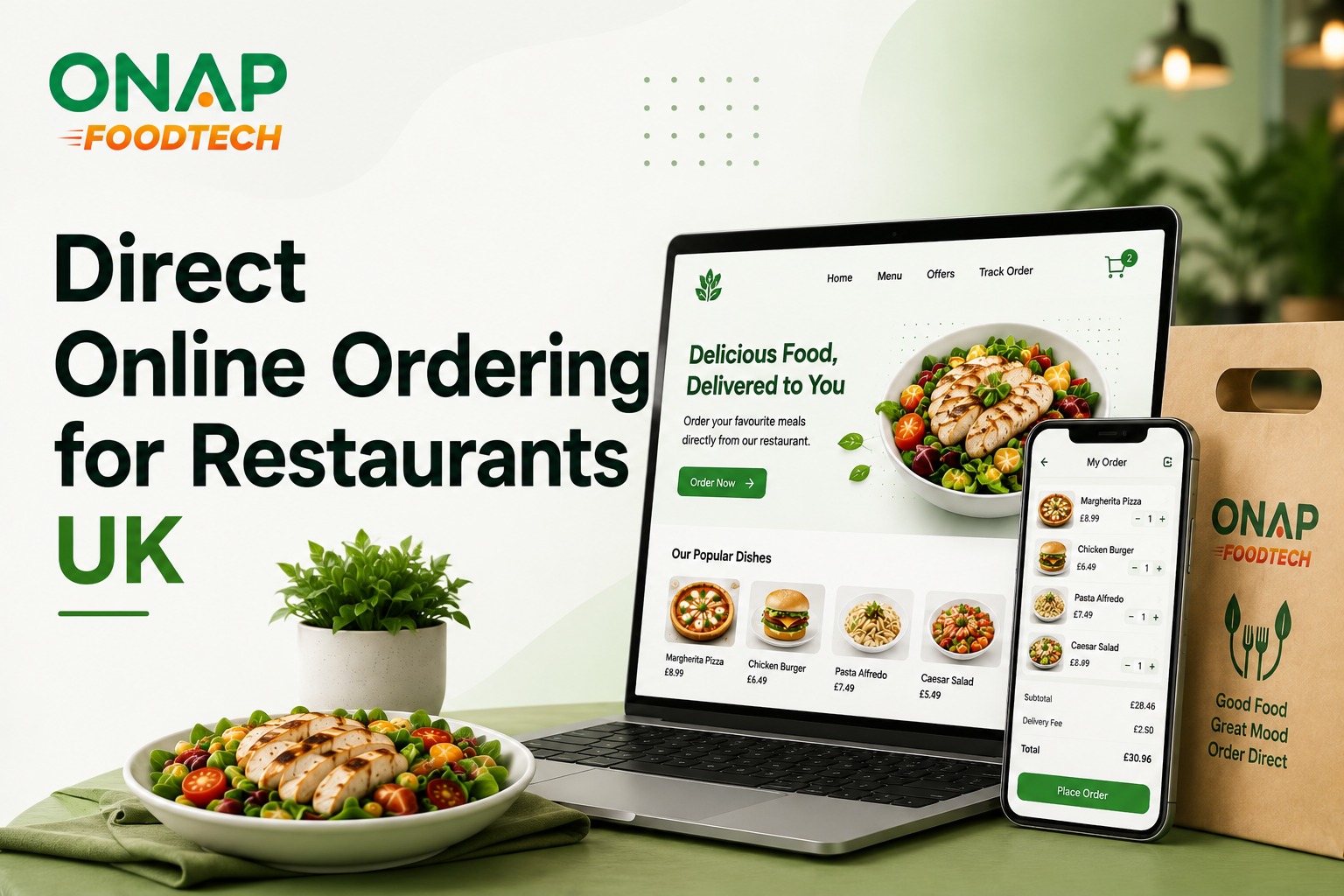
Table of Contents
- What direct online ordering means for a restaurant
- How to set up direct online ordering for your restaurant
- Connect the ordering system to your restaurant operations
- Make your direct ordering page easy to find
- Give customers a reason to order direct
- Direct online ordering and VAT in the UK
- Direct ordering vs marketplace ordering
- What should a restaurant look for in direct ordering software?
- How to move existing customers to direct ordering
- FAQs about direct online ordering for restaurants
- Can a restaurant take online orders without paying commission?
- How much does it cost to set up direct online ordering?
- Can I use direct ordering and Deliveroo or Just Eat together?
- How do I get customers to order directly from my restaurant?
- Do I need an app for direct restaurant ordering?
- Is direct online ordering better than using delivery apps?
- Conclusion
A direct online ordering system lets a restaurant take orders through its own website or branded ordering page, collect payment directly and avoid paying a marketplace commission on every order. For a restaurant already receiving regular takeaway orders, the change can be commercially meaningful, but only if the ordering journey is fast, reliable and easy for existing customers to find.
The opportunity is becoming more relevant as UK restaurants face tighter margins. UKHospitality reported that UK foodservice customer traffic fell 2.3% in Q1 2026, the sharpest quarterly decline since January 2024.
What direct online ordering means for a restaurant
Direct online ordering means customers place takeaway or delivery orders through a restaurant-owned channel rather than through a marketplace such as Deliveroo, Just Eat or Uber Eats. The restaurant controls the menu, customer journey, promotions and customer data, while payment is processed through the restaurant's chosen payment provider.
A marketplace can introduce a customer to your restaurant, but the relationship remains largely inside its platform. A direct ordering system gives you a route to build your own customer base, encourage repeat purchases and communicate with customers after an order.
For a small independent restaurant, that could mean adding an "Order Online" button to its existing website. A larger group might use branded ordering pages connected to its POS, CRM, loyalty programme and delivery operation.
How to set up direct online ordering for your restaurant
The practical process involves six main stages:
- Choose your ordering model.
- Build the online menu.
- Connect online payments.
- Set up collection and delivery.
- Connect orders to restaurant operations.
- Promote the direct ordering channel.
The technology matters, but the customer journey matters more. If someone has to search through three pages before finding the menu, the system is already losing orders.
1. Choose how customers will place orders
Start with the customer-facing channel.
For most restaurants, the strongest starting point is a mobile-friendly ordering page hosted under the restaurant's own brand. Customers should be able to reach it from the website, Google Business Profile, social media profiles, email campaigns, QR codes and printed packaging.
You can also use:
- A branded ordering website
- An ordering page connected to your existing website
- A restaurant mobile app
- QR codes linking directly to the menu
- Ordering links in email and SMS campaigns
- Social media links
- QR codes printed on receipts and takeaway bags
A 40-seat Indian restaurant in Birmingham, for example, does not need to launch a mobile app on day one. A fast ordering page, clear menu and reliable payment process may be enough to move repeat customers away from marketplace ordering.
For restaurants looking at a wider restaurant technology stack, ONAP FoodTech's restaurant software features include the types of ordering, CRM and customer management capabilities that can sit around a direct ordering channel.
2. Build a menu designed for online ordering
Your printed menu and online menu should not necessarily be identical. Online customers scan rather than read. They want to find a dish, customise it and pay quickly.
Organise the menu into clear categories such as:
- Starters
- Mains
- Sides
- Burgers or pizzas
- Meal deals
- Drinks
- Desserts
- Family options
Use accurate descriptions, good product photography and clear pricing.
Add modifiers where customers need to make choices. A pizza restaurant might offer size, base and toppings. A curry restaurant could allow spice preferences or side selections.
3. Connect a secure online payment provider
Customers expect to pay online, so your ordering system needs a dependable payment process.
Common payment methods for UK restaurants include:
- Debit and credit cards
- Apple Pay
- Google Pay
- Other supported digital wallets
Your payment setup should also handle refunds, failed payments and order cancellations properly.
Do not treat payment as an afterthought. A customer who reaches checkout and encounters a failed payment may simply return to a marketplace where their card details are already stored.
4. Decide how delivery will work
Removing marketplace commission does not mean delivery becomes free. You still have to pay for drivers, fuel, insurance, packaging, delivery software or a third-party courier service where applicable.
There are three common approaches:
| Delivery model | Main advantage | Main drawback | Best suited to |
|---|---|---|---|
| Restaurant-owned drivers | Maximum control | Staffing and vehicle costs | Restaurants with steady local demand |
| Third-party courier | Less delivery management | Courier charges still apply | Restaurants without drivers |
| Collection only | Lowest operational cost | Smaller addressable market | Local restaurants with strong footfall |
A restaurant in Leeds could promote direct collection orders with a small customer incentive while keeping delivery available at a separate fee. That can make the economics easier to control without removing convenience.
Set a realistic delivery radius too. A 25-minute delivery radius may sound attractive, but long journeys can damage food quality and increase driver costs.
Connect the ordering system to your restaurant operations
A direct ordering website is only useful if the kitchen receives the order accurately. Ideally, an incoming order should move through the process without staff having to manually copy information from a website into the till.
Look for connections with:
- EPOS systems
- Kitchen display systems
- Payment providers
- Delivery platforms
- Accounting software
- CRM systems
- Loyalty programmes
- Customer messaging tools
- Reporting dashboards
A restaurant taking 10 direct orders per day might manage manual entry for a while. At 100 orders per day, duplicate entry becomes a source of mistakes.
This is where restaurant management software for UK businesses becomes relevant. Direct ordering works better when the ordering, customer and operational sides of the restaurant are connected rather than operating as separate systems.
Make your direct ordering page easy to find
A technically perfect ordering system will not produce many orders if customers cannot find it. Your website should place the ordering option prominently on the homepage.
Order Direct: Rather than hiding the link under a generic "Menu" button. Then repeat the link across the places customers already interact with your restaurant.
Use Google to capture local demand
Customers searching for "pizza near me", "Indian takeaway in Manchester" or a specific restaurant name are already close to making a purchase. Keep your restaurant's name, address, telephone number, opening hours and ordering link accurate across your online presence.
Use packaging to bring customers back
This is one of the cheapest parts of the strategy. Add a QR code to takeaway bags, boxes, receipts or flyers with a message such as:
Next time, order direct from us. The QR code should take customers straight to the ordering page, not the website homepage.
Use loyalty to encourage repeat orders
A customer who has already ordered once is easier to reach than someone discovering the restaurant for the first time. Direct ordering gives restaurants more scope to build first-party customer relationships, subject to the relevant privacy and marketing requirements.
A loyalty programme could reward:
- Repeat orders
- Collection
- Higher basket values
- Birthday purchases
- Referral activity
- Specific quiet trading periods
UKHospitality reported that restaurant promotions increased 23% during H1 2025, while promotional activity on delivery platforms increased 93% during the same period.
Give customers a reason to order direct
Simply replacing a marketplace link with your own website is unlikely to change behaviour. Customers need a reason to switch.
That reason could be:
- Lower delivery fees
- A collection discount
- Loyalty points
- A free side after a certain number of orders
- Exclusive meal deals
- Direct-order-only products
- Faster collection
- Personalised offers for repeat customers
Avoid making your direct menu more expensive than the marketplace menu unless there is a clear commercial reason.
Customers are price-sensitive. UKHospitality's 2025 research found that 63% of consumers surveyed had reduced their spending on restaurant purchases, including dine-in, takeaway and delivery, during the previous 12 months. The better strategy is to protect your margin while making the direct channel feel like the sensible place to order.
Direct online ordering and VAT in the UK
Your ordering system must reflect the VAT treatment that applies to the food and service you sell. HMRC states that hot takeaway food and drink is generally subject to the standard 20% VAT rate, while many cold takeaway foods can be zero-rated, subject to the relevant rules and exceptions.
A restaurant selling hot pizzas, cold bottled drinks and other products may have different VAT treatments across its menu. The ordering system needs to pass the correct information into your sales and accounting records.
If your menu has complicated VAT categories, get your accountant to confirm the treatment before publishing the online menu.
Direct ordering vs marketplace ordering
A direct ordering channel should not always replace third-party marketplaces. For many restaurants, the stronger model is to use both.
| Factor | Direct ordering | Third-party marketplace |
|---|---|---|
| Customer relationship | Restaurant-controlled | Platform-controlled |
| Commission | No marketplace commission, but other costs apply | Marketplace fees or commission may apply |
| Customer acquisition | Restaurant must generate demand | Marketplace provides discovery |
| Customer data | Greater control, subject to privacy rules | Access is more restricted |
| Branding | Restaurant-owned | Marketplace-led |
| Repeat marketing | Restaurant can build its own programme | More dependent on platform |
| Delivery | Restaurant or chosen provider | Often integrated into marketplace |
| Best use | Repeat customers and loyalty | New customer discovery |
The commercial case is strongest when the restaurant uses marketplaces for discovery and direct ordering for retention. That is a more realistic strategy than expecting every marketplace customer to disappear overnight. Restaurants considering alternatives to third-party platforms can also review FoodTech's restaurant software alternatives when assessing different approaches to ordering and restaurant management.
What should a restaurant look for in direct ordering software?
Before choosing a platform, score it against the operation you already have.
| Capability | Why it matters |
|---|---|
| Branded ordering page | Keeps customers within your own brand |
| Mobile ordering | Supports customers ordering from phones |
| Online payments | Removes manual payment handling |
| Menu management | Allows prices and products to be updated quickly |
| Collection and delivery | Supports different fulfilment models |
| POS integration | Reduces duplicate order entry |
| CRM | Helps manage customer relationships |
| Loyalty | Encourages repeat direct orders |
| Reporting | Shows sales, order values and customer behaviour |
| Marketing tools | Helps bring customers back |
| API or integrations | Connects the ordering channel to other systems |
| Support and onboarding | Reduces problems during launch |
A single-site café may need a focused ordering setup. A 12-site casual dining group needs stronger reporting, customer management, location controls and integrations. If you are comparing platforms, ONAP FoodTech pricing and capabilities can be one reference point when building your shortlist.
How to move existing customers to direct ordering
The first customers to target are people who already know your restaurant.
You can promote the direct channel through:
- Printed receipts
- Takeaway packaging
- SMS, where customers have provided the appropriate consent
- Social media
- QR codes
- Website banners
- Loyalty communications
- In-store signage
For example, a restaurant could offer a direct-order collection reward rather than discounting every delivery order. Measure the results. Track direct order volume, average order value, repeat order rate, collection versus delivery, customer acquisition source and promotional cost.
The goal is not to move every order to one channel. It is to build a healthier mix of orders where the restaurant owns more of the customer relationship.
FAQs
Can a restaurant take online orders without paying commission?
Yes, a restaurant can take direct online orders without paying a third-party marketplace commission on each order. You still need to account for software, payment processing, delivery, hosting and other operating costs. The commercial advantage comes from controlling the ordering relationship and avoiding marketplace commission structures, rather than from having no costs at all.
How much does it cost to set up direct online ordering?
The cost varies according to the software, payment provider, integrations and delivery model you choose. A basic ordering page can require less investment than a fully integrated system connected to EPOS, CRM, loyalty and delivery operations. Ask providers for the complete cost structure, including subscriptions, transaction fees, setup charges and any optional features.
Can I use direct ordering and Deliveroo or Just Eat together?
Yes, restaurants can use direct ordering alongside third-party marketplaces. This is often a sensible approach because marketplaces can help with customer discovery, while direct ordering gives the restaurant greater control over repeat customers. Keep menus, prices, availability and operating hours accurate across each channel to avoid cancelled orders and customer frustration.
How do I get customers to order directly from my restaurant?
Give existing customers a clear reason to use your direct channel, such as collection rewards, loyalty points, exclusive meals or lower delivery costs. Promote the ordering link on your website, packaging, receipts, social media and customer communications. A QR code that opens the ordering page directly is more useful than one that sends customers to a general homepage.
Do I need an app for direct restaurant ordering?
No, most restaurants do not need a dedicated mobile app to start taking direct orders. A fast, mobile-friendly ordering website can handle the core journey without requiring customers to install anything. An app becomes more relevant when a restaurant has a substantial repeat customer base and wants deeper loyalty, personalised marketing or app-specific customer features.
Is direct online ordering better than using delivery apps?
Direct online ordering is often better for repeat customers because the restaurant has more control over branding, customer relationships and marketing. Delivery marketplaces can still be useful for reaching new customers. For many UK restaurants, the practical approach is to use marketplaces for discovery while encouraging satisfied customers to place future orders directly.
Conclusion
Start with the economics rather than the technology. Calculate how many orders currently come through third-party platforms, the average order value, the fees associated with those orders and how many customers order repeatedly. Then decide what proportion you could realistically move to a direct channel over the next three to six months.
Next, build a mobile-first ordering journey with your real menu, connect payments and test the complete kitchen workflow. Once the system works, promote it to people who already buy from you. Packaging, receipts, loyalty communications and QR codes can turn an existing customer into a direct customer without requiring a large advertising budget.
For restaurants wanting one system covering online ordering, customer management, loyalty and restaurant operations, ONAP FoodTech is designed around these restaurant technology requirements.
The strongest direct ordering strategy is not about abandoning every marketplace. It is about making sure your restaurant has a customer-owned channel that works well enough for people to choose it again.
Explore More Blogs
Discover more expert insights, software guides, and industry best practices to help your business grow with ONAP.
How to Launch a Branded Restaurant App Without a Developer (UK Guide 2026)
Launching a branded restaurant app no longer requires an in-house development team. This 2026 UK guide explains how restaurant owners can choose a no-code or managed app platform, connect ordering and payments, build loyalty features, publish the app, and avoid the common mistakes that make app projects expensive.
Field Service Engineer Scheduling Software UK: Free vs Paid Options Compared
Field service engineer scheduling software helps UK contractors assign jobs, manage availability, track engineers and keep customers updated. This guide compares free scheduling tools, spreadsheets and paid field service platforms, including their features, limitations, costs and suitability for growing teams.
Café vs Cloud Kitchen vs Dark Kitchen: Which Model Works Best for UK Food Businesses
Cafés, cloud kitchens and dark kitchens each suit different UK food businesses. This guide compares premises, staffing, startup costs, delivery economics, customer acquisition, technology, VAT and growth potential, helping operators choose the model that fits their menu, target market and available capital.